Paediatric Ophthalmology
Children rarely say their vision is poor — they simply adapt
A child born with a weak eye has no memory of anything better, so nothing seems wrong to them. They tilt, squint, sit closer, and get on with it. That adaptation is exactly what hides the problem, and it is why a child eye check is a measurement, not a conversation.
Why a child will not tell you
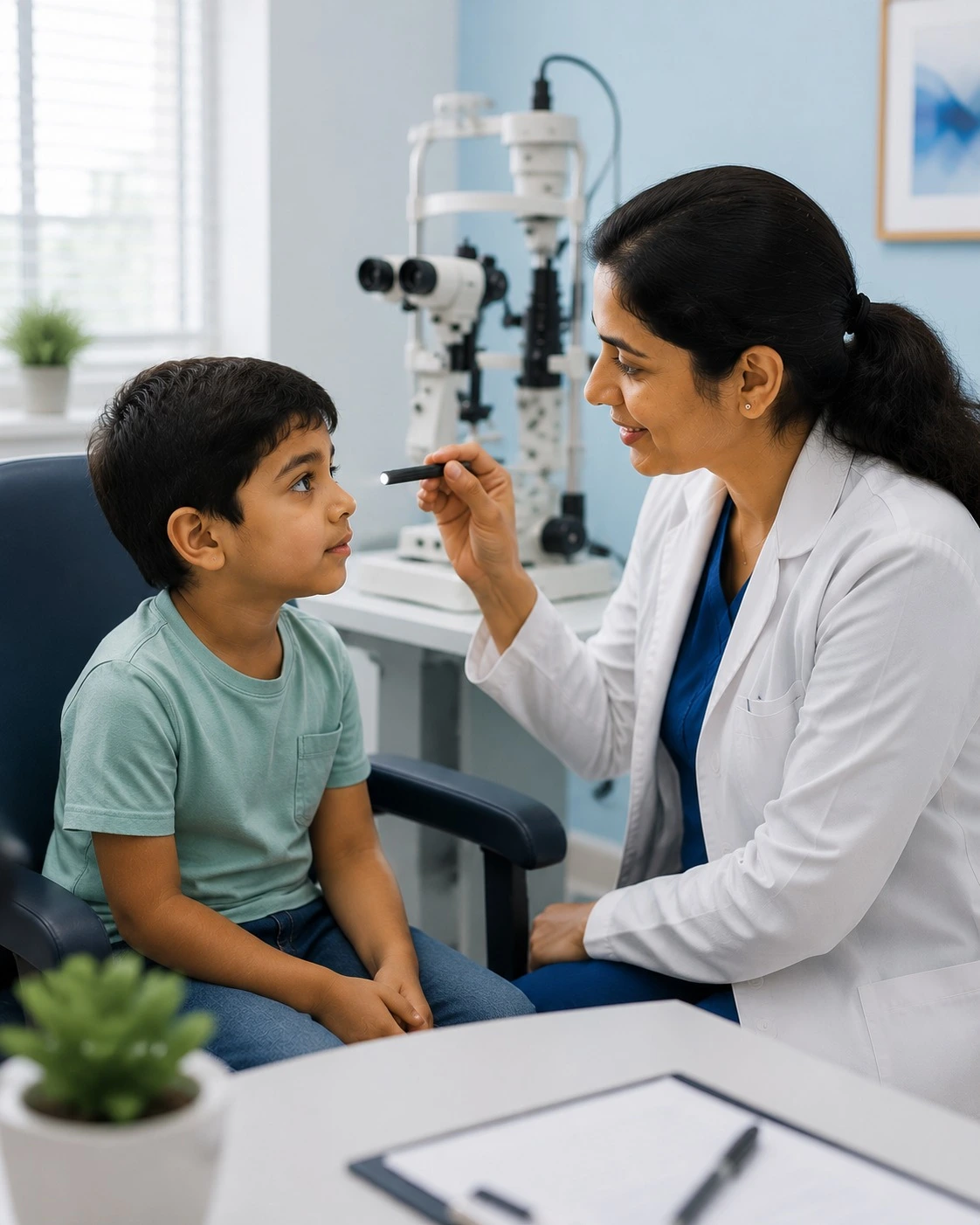
Vision is not something a child can compare. If one eye has been blurred since birth, the blur is normal to them, and the other eye quietly does all the work. Nothing hurts, nothing looks obviously different, and the child performs well enough at close range that most families notice nothing until a school screening or a photograph raises the question.
The eye and the visual part of the brain finish most of their development in the first eight years or so. Treatment given inside that window can restore vision almost completely. The same treatment given at twelve often cannot. That is the entire argument for screening children who seem perfectly fine.
Not sure if this applies to you?
A single examination answers it definitively. If you do not need treatment, we will tell you that too — and when to come back.
What to actually watch for
None of these prove there is a problem. Each one is a reason to have the eyes measured rather than wait and see.
A white reflex in photographs
If the flash makes one pupil glow white or yellow instead of red, bring the child in this week. It can be a cataract, and occasionally a retinoblastoma. Do not wait for the next holiday.
One eye drifting or turning
Inward, outward, up or down, constant or only when tired. A turn that persists beyond four months of age is never something a baby grows out of.
Sitting close to the TV, holding books close
The most common early sign of short-sightedness. Children move closer because it works, not because they are being difficult.
Tilting or turning the head to look
A consistent head posture is often the child compensating for a squint or for uneven astigmatism. It shows up in every family photograph once you start looking.
Squeezing, rubbing or blinking hard
Persistent rubbing suggests either uncorrected power or allergy. Both are treatable, and heavy rubbing over years can weaken the cornea.
Headaches, poor school work, clumsiness
Complaints of headache after reading, falling marks, skipping lines, or bumping into things at play. Vision is the cheapest of these problems to rule out.
A white pupil in a photograph, a sudden squint, an eye injury or an eye that has become red and painful are all same-day problems. Call +91 90001 80035, or the 24x7 line on +91 40-4245 6666.
Short sight, long sight and astigmatism in children
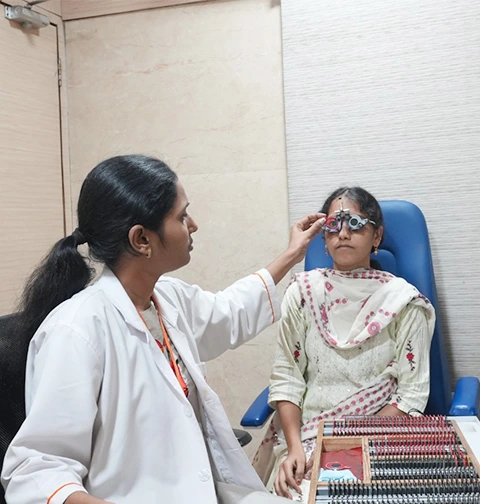
Power in a child is not measured the way it is in an adult. Their focusing muscle is strong enough to hide a real prescription, so we relax it with drops before we believe any number.
Myopia is rising, and it is rising fast
Short-sightedness in Indian school children has climbed sharply over the last two decades, and it is starting younger. A child who becomes myopic at seven usually ends up with a much higher power than one who becomes myopic at twelve, because the eye keeps growing.
Outdoor time and screen breaks genuinely help
This is one of the few areas where lifestyle advice is backed by real trials. Around two hours a day of outdoor daylight slows the onset of myopia. So does holding reading material at arm's length, with a break every twenty minutes. Neither reverses existing power, and no exercise ever will.
Hypermetropia is the one parents miss
Long sight is normal in small children and usually reduces with age. But a high hidden hypermetropia is the commonest cause of an inward squint, and correcting it with glasses alone can straighten the eyes completely.
Astigmatism blurs everything, near and far
Uneven corneal curvature makes print smear rather than simply blur. Children with astigmatism often tilt their heads or complain most in the evening, when they are tired.
When we slow progression
For a child whose power is climbing year on year, we discuss low-dose atropine drops or specialised spectacle and contact lens designs. These reduce the rate of change; they do not stop growth or remove existing power. We show you the axial length numbers so you can see whether it is working.
Amblyopia, and why the timing decides the outcome
Amblyopia is not a problem of the eye. It is the brain learning to ignore an eye that gave it a poor image during early childhood. Glasses alone will not fix it once that habit is set.
- What causes itAnything that blurs or misaligns the image in one eye during the first years: a difference in power between the two eyes, a squint, a droopy lid, or a childhood cataract.
- Why it is silentThe good eye compensates entirely. Vision feels normal to the child, school work is fine, and the weak eye is often found only when someone covers the strong one.
- The critical windowTreatment works best under the age of about eight, and best of all under five. After roughly ten years, gains become small and slow. This is a genuine deadline, not a sales line.
- Glasses first, for several weeksA good proportion of amblyopia improves substantially with full-time correct spectacles alone. We give that time to work before adding anything else.
- PatchingThe strong eye is covered for a set number of hours a day, forcing the weak one to work. Modern practice uses two to six hours, not all day. It works, and the hardest part is compliance, not the medicine.
- Atropine penalisationA drop that blurs near vision in the strong eye, used when patching is refused or the skin will not tolerate it. Results are broadly comparable to part-time patching for mild to moderate cases.
- Then holding on to the gainVision can slip back after treatment stops, so we taper rather than stop abruptly and keep reviewing until the visual system is mature.
Be prepared for a treatment measured in months. Patching for six weeks and giving up is the most common reason amblyopia treatment fails, and it is the one thing entirely within a family's control.
Other conditions we treat in children
Some of these are urgent, some can be watched. The table tells you which is which.
| Condition | What you might notice | How urgent | Usual approach |
|---|---|---|---|
| Squint (strabismus) | An eye turning in, out or up; head tilting; double vision in older children | Weeks, not years | Glasses, patching, prisms, and surgery to align the muscles when needed |
| Paediatric cataract | White or grey pupil, poor fixation, wandering eyes in a baby | Urgent in infancy | Early surgery, then lifelong follow-up for glasses and amblyopia treatment |
| Retinopathy of prematurity | Nothing visible at all; found only on screening | Screen at 4 weeks of life | Monitoring, laser or injection depending on stage |
| Paediatric glaucoma | Large watery eyes, cloudy cornea, strong dislike of light in a baby | Urgent | Pressure control, usually surgical, and long-term monitoring |
| Blocked tear duct | Watering and sticky discharge from one eye in an infant | Watch to 12 months | Massage and hygiene first; probing if it persists past a year |
| Allergic conjunctivitis | Itching, rubbing, redness, stringy discharge; worse in season | Not urgent, but treat it | Drops, allergen avoidance, and stopping the rubbing before it damages the cornea |
| Eye injury | Any blunt or sharp injury, chemical splash, or a stuck foreign body | Same day | Immediate examination; do not press the eye or attempt to remove anything at home |
Retinopathy of prematurity is the one condition on this list where a screening delay of a few weeks can cost a baby their sight permanently. If your baby was born before 34 weeks or under 2 kg, book the screening before you leave the nursery.
How we treat, in plain terms
Most children need glasses and follow-up, not an operation. We start with the least we can get away with.
Correct spectacles, worn properly
The single most effective intervention in paediatric eye care. We check the fit, because a well-prescribed lens sitting halfway down the nose corrects nothing.
Amblyopia therapy
Patching or atropine, with a written schedule and a review every four to eight weeks so the plan changes when the numbers change.
Myopia progression control
Low-dose atropine or a specialised lens design, alongside outdoor time. Reviewed with axial length measurement, not guesswork.
Orthoptic exercises
Useful for convergence problems and for building fusion after a squint is aligned. Not a cure for a large squint, and we will say so rather than sell sessions.
Surgery when it is required
Squint correction, paediatric cataract, glaucoma and lid surgery are done under general anaesthetic by surgeons who operate on children regularly, with a paediatric anaesthetist present.
Long follow-up
Children change. A prescription at four is not a prescription at seven, and an aligned eye can drift. We keep reviewing until the visual system is mature.
Check the eyes before there is a complaint
A child with a serious eye problem usually looks and behaves like a child without one. Screening exists precisely because symptoms cannot be relied upon.
The window closes
Amblyopia caught at four is usually reversible. The same amblyopia found at eleven often is not, however good the treatment.
School results improve
Children labelled inattentive or slow are sometimes simply unable to read the board. A pair of glasses has changed more school reports than any tutor.
Behaviour makes sense afterwards
Reluctance to read, avoiding ball games, clumsiness on stairs — these often turn out to be visual, and they resolve once the vision does.
Some findings are time-critical
Paediatric cataract, glaucoma, ROP and retinoblastoma are all found on routine examination and all get worse with delay.
Family history raises the stakes
If a parent or sibling has a squint, a high power, childhood glaucoma or a lazy eye, start screening earlier and repeat it more often.
When a child should have their eyes checked
| Age | What is checked | How often |
|---|---|---|
| Newborn | Red reflex, lid and eye structure, at the first paediatric visit | Once, in the first month |
| Premature baby (under 34 weeks or under 2 kg) | ROP screening by indirect ophthalmoscopy | From 4 weeks of life, then as advised |
| 6 months | Fixation, eye alignment, any turn or head posture | Once |
| 3 years | Vision with picture charts, squint and refraction under drops | Once |
| 5 to 6 years, before school | Full vision, refraction, alignment and eye health | Once, before the school year begins |
| 6 years and above, no problems found | Vision, power check and eye health | Every 2 years |
| Wearing glasses, or under treatment for amblyopia or squint | Power, alignment, and progress against the plan | Every 6 to 12 months, or as advised |
| Any warning sign at any age | Full paediatric examination | Now, without waiting for the next cycle |
The equipment behind the diagnosis
A recommendation is only as good as the measurement it rests on. These are the machines your findings come from.
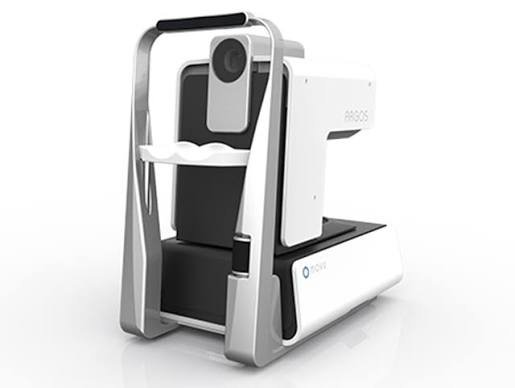 Cycloplegic retinoscopy and auto-refraction
Measures a child's true power with the focusing muscle relaxed
Cycloplegic retinoscopy and auto-refraction
Measures a child's true power with the focusing muscle relaxed
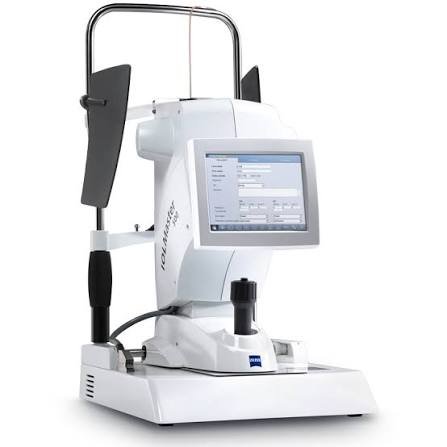 IOLMaster 700 biometry
Tracks axial length to show whether myopia is still progressing
IOLMaster 700 biometry
Tracks axial length to show whether myopia is still progressing
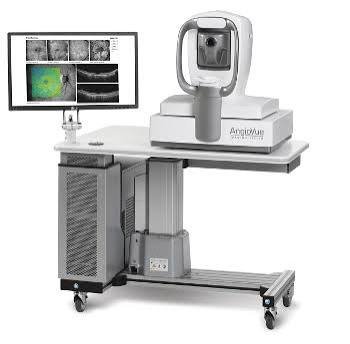 OCT and OCT Angiography
Retina and optic nerve scans without touching the eye
OCT and OCT Angiography
Retina and optic nerve scans without touching the eye
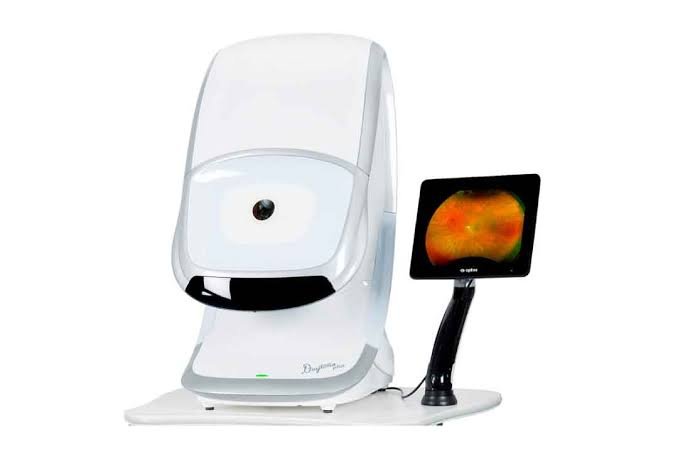 Optos ultra-widefield imaging
A wide retinal photograph in a fraction of a second, useful with restless children
Optos ultra-widefield imaging
A wide retinal photograph in a fraction of a second, useful with restless children
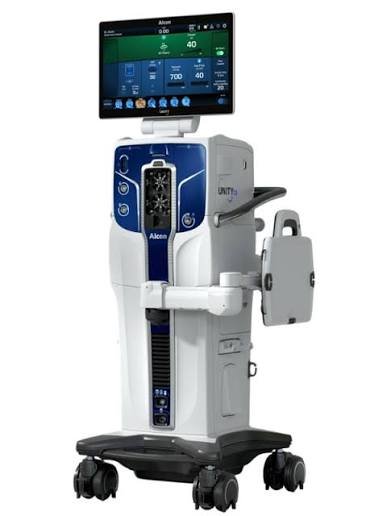 Alcon UNITY Vision System
Paediatric cataract surgery with a stable, controlled anterior chamber
Alcon UNITY Vision System
Paediatric cataract surgery with a stable, controlled anterior chamber
Step by step, from first visit to final review
No surprises. Here is exactly how this unfolds.
-
Booking and what to bring
Tell us the child's age when you book so we can allow enough time. Bring previous prescriptions, any patching records, the birth history if the child was premature, and a snack. Expect to be with us for one to two hours if dilating drops are used.
-
Vision testing at the child level
Picture charts, matching cards or fixation behaviour, depending on age. A toddler who cannot name letters can still be tested reliably; we use what the child can do rather than what a chart expects.
-
Cycloplegic refraction
Drops relax the focusing muscle so the true power can be measured. Vision goes blurry for near work and the pupils stay large for four to twenty-four hours. Sunglasses or a cap help on the way home.
-
Alignment and eye health check
Cover tests and orthoptic assessment for squint, then a dilated examination of the lens, retina and optic nerve. For a premature baby this is an indirect ophthalmoscopy ROP screening.
-
Explaining the plan to both of you
We tell you what we found, whether glasses are actually needed, and what happens if you do nothing. Where treatment is optional, we say so. Where it is time-critical, we say that too, plainly.
-
Follow-up that does not drift
Amblyopia is reviewed every four to eight weeks, glasses every six to twelve months, and treated squints for years. We give you the next date before you leave, because vision that improves and is then left alone can slip back.
Why patients choose us for paediatric
An examination room built for children
Cartoon fixation targets, toys, no white coats where they are not needed, and staff who will wait rather than force. A frightened child gives unreliable readings.
Since 1993, across five centres
Thirty-four years of paediatric practice and more than 6,25,000 patients means we have seen the rare conditions often enough to recognise them early.
Diagnosis before treatment
No child is put into glasses on an auto-refractor reading alone. Cycloplegic refraction and a dilated examination come first, every time.
NABH-accredited paediatric surgery
When surgery is needed, it is done with a paediatric anaesthetist and independently audited theatre and safety protocols.
Honest about what is not needed
Many children who come in for a check leave with nothing but a review date. We will not prescribe a lens, a therapy package or a drop that the measurements do not support.
Consultants who handle paediatric
The same consultants practise across our centres — you get the specialist, not the postcode.

Where paediatric is available
Listed plainly so you do not travel to the wrong centre.
| Centre | Status | What is offered |
|---|---|---|
| Masab Tank, Hyderabad | Available | Paediatric cataract, ROP screening, examinations under anaesthesia |
| KPHB, Kukatpally | Available | Children's eye examinations, amblyopia and glasses |
| Warangal | Available | Children's vision testing and amblyopia management |
| Nalgonda | Available | Children's eye testing and amblyopia management |
| Badvel, Kadapa | Available | Children's vision screening |
Paediatric Ophthalmology — your questions answered
At what age should a child have their first eye check?
The first is at birth, when the paediatrician checks the red reflex. After that, a check at around six months, again at three years, and a full examination before school at five or six. If the child was premature, ROP screening starts at four weeks of life and cannot wait for these milestones.
Is the school vision test enough?
No. School screenings usually test distance vision on a chart with both eyes open, which misses long-sightedness, mild amblyopia, small squints and everything at the back of the eye. They are a useful net for gross problems and nothing more. A child who passes a school test can still have a significant refractive error or a lazy eye.
Does patching actually work?
Yes, and it is well proven in large trials. Two to six hours of daily patching improves vision in most children with amblyopia, provided the underlying cause is corrected first and the child is young enough. The treatment fails far more often from stopping early than from being ineffective, so plan for months rather than weeks.
Will my child have to wear glasses forever?
It depends on the reason. Long-sightedness in a young child often reduces with age and the glasses can sometimes be reduced or stopped. Short-sightedness usually increases through the growing years and then stabilises in the late teens, so those glasses are generally permanent unless the child later chooses contact lenses or, as an adult, laser correction. Astigmatism tends to stay much as it is.
Can squint surgery be done safely on a young child?
Yes. It is a procedure on the muscles outside the eye, not inside it, and it is routine in children as young as one when the squint warrants it. It is done under general anaesthetic with a paediatric anaesthetist, usually as a day case. The eye is red and sore for a week or two, and roughly one child in five needs a second procedure later for a residual or recurrent turn, which we will tell you before you consent.
Can a child under two really be examined properly?
Yes. We do not need the child to read or answer anything. Fixation behaviour, how the child objects when one eye is covered, retinoscopy under drops and a dilated examination of the retina give us a complete picture. Babies are usually examined on a parent's lap, and a crying child can still be examined reliably.
Should I see an optometrist or a paediatric ophthalmologist?
An optometrist measures power and dispenses glasses, which is enough when the only issue is a straightforward prescription. A paediatric ophthalmologist is a doctor who can also diagnose and treat squint, amblyopia, cataract, glaucoma and retinal disease, prescribe cycloplegic drops and operate. If there is a squint, a difference between the two eyes, an abnormal reflex, a family history, or the child is under three, see the ophthalmologist.
Are the dilating drops safe, and how long do they last?
They are safe and used routinely in children worldwide. The pupils stay large and near vision stays blurred for four to twenty-four hours depending on which drop is used, so bright light is uncomfortable and homework that evening is not realistic. Occasionally a child gets a flushed face or feels warm for a few hours. It settles on its own.
Can screen time be blamed for my child needing glasses?
Partly, but the better evidence points to a lack of outdoor daylight and long unbroken periods of close work rather than screens specifically. Around two hours a day outdoors reduces the chance of becoming short-sighted, and a break every twenty minutes helps once close work starts. Genetics still matters most: two myopic parents make it far more likely regardless of habits.
What does a paediatric eye consultation cost?
A consultation with cycloplegic refraction is charged as a standard specialist consultation, with the drops and dilated examination included. Additional imaging such as OCT is billed separately and only when it is indicated. You get the figure at the desk before any test is done, and surgical estimates are given in writing with insurance and Aarogyasri cover checked in advance.
Often looked at alongside this
Squint Treatment
Squint correction at any age — glasses, prisms, therapy or surgery, depending on what is actually causing the turn.
Learn moreComprehensive Ophthalmology
A full diagnostic examination that checks the whole eye — not just what prescription you need.
Learn moreRetina Care
Diabetic retinopathy, macular degeneration and retinal detachment — screened early, treated with injections, laser or vitrectomy.
Learn moreOculoplasty
Ptosis correction, eyelid reconstruction, thyroid eye disease and blocked tear ducts — functional surgery around the eye.
Learn moreGet your child's eyes measured, not guessed at
One examination tells you whether there is anything to treat. If there is nothing, that is a real answer worth having, and we will tell you when to come back.