Squint Treatment
Eyes that work together, at four years old or forty
A squint is not a habit, and children do not grow out of a constant one. It is a sign that something is off in the focusing, the muscles or the nerves, and the first job is to find out which. Some squints straighten with nothing more than the correct pair of glasses.
What a squint actually is
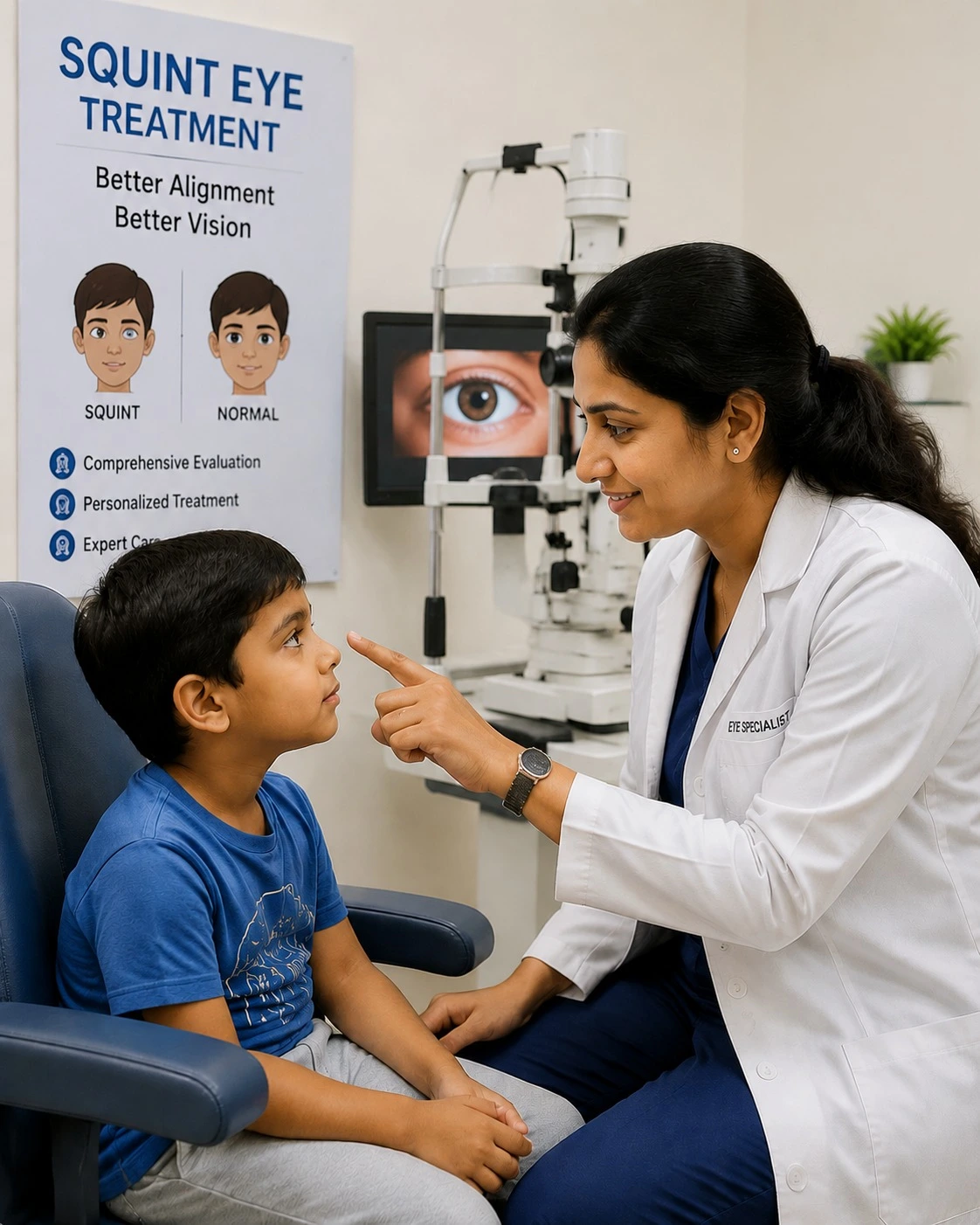
Six small muscles move each eye, and the brain drives all twelve of them together so that both eyes land on the same point at the same moment. A squint, or strabismus, is what you see when that coordination fails: one eye looks at the object, the other drifts in, out, up or down.
The brain then receives two different pictures. A young child solves this by switching off the image from the turning eye, which is why a squint so often ends in a lazy eye. An adult has no such option and sees double instead. That difference explains almost everything about how the two age groups are treated.
A squint is a sign, not a diagnosis. The turn itself can be measured in a few minutes; the useful work is establishing why the eye is turning, because that is what decides whether the answer is spectacles, patching, prisms or surgery.
Not sure if this applies to you?
A single examination answers it definitively. If you do not need treatment, we will tell you that too — and when to come back.
Types of squint
Which way the eye turns, and whether it turns all the time, changes both the likely cause and the treatment. These are the patterns we see most often.
Esotropia (inward turn)
The commonest squint in Indian children. One eye turns towards the nose. When it appears between two and four years of age it is very often driven by uncorrected long sight, and a full spectacle correction can straighten it completely.
Exotropia (outward turn)
The eye drifts outward, classically when the child is tired, unwell or daydreaming. It often starts intermittently and becomes more frequent over years, which is why it is worth measuring on more than one visit.
Vertical squint (hyper or hypotropia)
One eye sits higher or lower than the other. Vertical deviations are less common and more often linked to a fourth nerve problem or an old head injury, so they are investigated more thoroughly.
Intermittent squint
Present some of the time and absent the rest. Parents are often told they are imagining it because the eyes look straight in the clinic. Photographs and videos from home are genuinely useful evidence, so bring them.
Constant squint
The eye is turned at all times. In a young child this carries the highest risk of amblyopia, because the brain has no reason ever to use that eye. A constant turn after four months of age always needs assessment.
Paralytic squint (nerve palsy)
A third, fourth or sixth cranial nerve is not working, so the eye cannot move fully in one direction. The angle changes depending on where you look, and double vision is usual. Sudden onset in an adult needs same-day attention.
Pseudosquint (a turn that is not there)
A broad nasal bridge or wide inner eyelid folds can make a perfectly straight eye look turned in, especially in photographs and in babies. It is common, it needs no treatment, and only an examination can separate it from the real thing.
What causes an eye to turn
Squint is the end result of several very different problems. Treating it without knowing which one you are dealing with is guesswork.
- Uncorrected refractive errorA long-sighted child focuses hard to see clearly, and focusing pulls both eyes inward. This accommodative esotropia is the single most treatable cause: the right glasses, worn full time, often straighten the eyes entirely.
- Imbalance in the eye musclesThe muscles or their attachments differ slightly in strength or position from birth. Nothing was done wrong and nothing was missed. This is the group that most often needs surgery.
- Nerve palsyDamage to the third, fourth or sixth cranial nerve stops a muscle working. Causes range from birth injury to diabetes, hypertension, trauma and, less often, a problem inside the head. Many microvascular palsies recover on their own in three to six months.
- Poor vision in one eyeAn eye that cannot see well loses its incentive to stay aligned and drifts, usually outward. A dense childhood cataract, corneal scar, optic nerve problem or, rarely, a retinoblastoma can present exactly this way, which is why every squint gets a dilated retinal examination.
- Neurological and developmental conditionsCerebral palsy, significant prematurity, Down syndrome, hydrocephalus and head injury all carry a higher rate of squint. These children usually need longer, more patient assessment and often a combined plan with their paediatrician.
- Thyroid eye diseaseThyroid disease can thicken and stiffen the eye muscles, restricting movement and producing double vision, often with lid retraction or prominent eyes. Alignment surgery here is done only once the disease has been stable for at least six months.
Signs that need an eye examination
Most parents notice something long before they act on it. This table is the plain version of what we would tell you on the phone.
| What you notice | What it often means | How soon to come in |
|---|---|---|
| Eyes wandering in a baby under 3 months | Usually normal while eye control develops | Mention it at the routine check |
| An eye that turns in or out after 4 months | A true squint, not newborn wandering | Within a few weeks |
| A constant turn at any age | Highest risk of a lazy eye developing | As soon as you can |
| Head turned or tilted to one side to see | The child has found the angle where the images fuse | Within a month |
| One eye closing in bright sunlight | Typical of intermittent exotropia | Within a month |
| Sitting very close to the TV, holding books close, squeezing eyes | Uncorrected power, often alongside a squint | Within a month |
| A child complaining of double vision | Uncommon in children and always worth investigating | Within a few days |
| Sudden squint or double vision at any age | Nerve palsy, stroke, trauma or raised pressure inside the head | Same day, as an emergency |
| Eye turn with a drooping lid or a prominent eye | Thyroid, orbital or neurological cause | Within a few days |
A wandering eye in the first three months of life is common and usually settles as control develops. A turn that is still present at four months, or any turn that is constant, needs an examination rather than reassurance from a well-meaning relative. Waiting to see if it settles is the one thing that reliably makes the outcome worse.
How a squint is measured
A squint work-up is longer than a routine eye test. Every one of these steps changes the plan, so none of them is skipped.
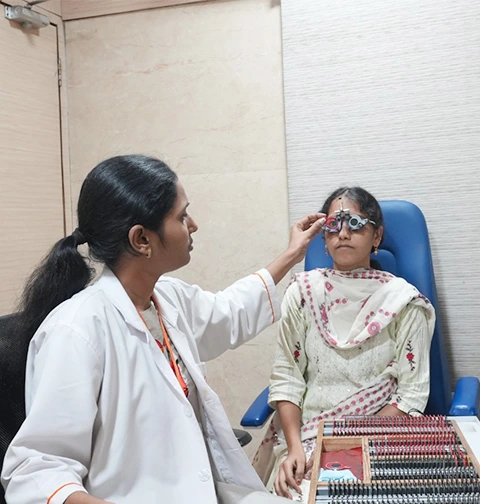
Visual acuity, each eye separately
Measured with letters, pictures or matching cards depending on age, and in pre-verbal children by watching how strongly they object to one eye being covered. A difference between the two eyes is the first clue to amblyopia.
Cycloplegic refraction
Dilating drops temporarily switch off the focusing muscle so the true spectacle power can be measured. Children over-focus so strongly that a refraction without these drops can miss several dioptres of long sight, which is exactly the number that matters in esotropia.
Cover and cover-uncover test
Covering one eye and watching how the other moves tells us whether there is a real squint, which eye is fixing, and whether the deviation is manifest or only latent. It takes seconds and it is still the backbone of the examination.
Prism cover test
Prisms of increasing strength are held over the eye until the movement stops. The prism that neutralises it gives the exact angle in prism dioptres, for distance and near, in every direction of gaze. Surgery is planned on these numbers.
Ocular motility
Each eye is followed through all directions of gaze, alone and together, looking for a muscle that under-acts or over-acts. This is what separates a paralytic squint from a comitant one, and it changes the operation entirely.
Diplopia charting and Hess screen
For adults and older children with double vision, we map exactly where in the field of view the two images separate and by how much. Repeating the chart over months shows whether a nerve palsy is recovering, which decides whether to wait or to operate.
Binocular vision and stereopsis
Tests of fusion and depth perception show how much of the two-eyed function has survived. A child who still has some stereopsis has more to protect and is usually treated sooner.
Anterior and posterior segment examination
A slit lamp look at the front of the eye and a dilated examination of the retina and optic nerve. This is where a childhood cataract, a corneal scar, an optic nerve anomaly or, rarely, a retinoblastoma is picked up as the real cause of the turn.
A full squint assessment takes roughly an hour, sometimes ninety minutes with a small child, and the dilating drops blur near vision for four to six hours. Plan the day around it and bring someone to help with the child on the way home.
What can be fixed without an operation
A good number of squints never reach theatre. These options come first, and in accommodative esotropia the first one is often the whole treatment.
Spectacles, prescribed on the cycloplegic reading
Many childhood inward squints correct fully with glasses alone, because the turn is being produced by the effort of focusing. The full correction has to be worn all waking hours, not only for study, and the eyes turn again the moment the glasses come off until the pattern settles. That is expected, not a failure of the glasses.
Patching and atropine for the lazy eye
Covering the stronger eye for a prescribed number of hours a day forces the weaker one to work. Atropine drops in the stronger eye achieve something similar for families who cannot manage a patch at school. Both treat the poor vision, not the turn, and neither straightens the eye.
Prism spectacles
A prism ground into the lens shifts the image so that both eyes see it in the same place, relieving double vision without surgery. It suits smaller and stable angles, recovering nerve palsies, and adults who are not fit for or not keen on an operation. Large angles need impractically thick prisms.
Orthoptic exercises
Exercises genuinely work for convergence insufficiency, where the eyes struggle to hold near alignment while reading, and they help some intermittent exotropias hold control for longer. They will not straighten a large or constant squint, and we would rather tell you that at the first visit than after six months of daily practice.
Treating the underlying condition
A microvascular sixth nerve palsy in a diabetic often recovers on its own once sugars are controlled, and thyroid eye disease needs the thyroid settled first. In both cases we hold off on surgery and manage the double vision with prisms or temporary occlusion while the picture stabilises.
What squint surgery involves
Surgery works on the muscles on the outside of the eyeball. The eye is never removed and the operation does not enter the eye itself.
- Recession (weakening a muscle)The muscle is detached and re-attached further back on the eye wall, which reduces its pull. The amount, measured in millimetres, comes straight from the prism cover test readings taken at your visits.
- Resection (strengthening a muscle)A measured length of muscle is removed and the muscle re-attached at its original site, so it pulls more effectively. Recession and resection are often combined in the same eye, one on each side, to rotate it into line.
- Adjustable suturesThe muscle is tied with a temporary slip knot instead of a permanent one. A few hours later, with you awake and only anaesthetic drops in the eye, the alignment is checked and the knot is tightened or loosened by a millimetre or two before it is tied off. It meaningfully improves accuracy in adults, re-operations, thyroid eye disease and nerve palsies. It needs a cooperative patient, so it is rarely used in young children.
- AnaesthesiaChildren have general anaesthesia, with a paediatric anaesthetist, a pre-operative fitness check and fasting instructions given in writing. Cooperative adults can often be done under local anaesthesia with sedation, which is what makes an adjustable suture possible.
- Recovery, honestly describedDay-care surgery, home the same evening. The eye is red, gritty and watery for two to four weeks and the redness can take six weeks to clear fully, which surprises people more than the pain does. Children are usually back at school in a week; adults with desk jobs, about the same.
- The risks worth knowingThe commonest problem is not a complication but an under- or over-correction, and a proportion of patients need a second procedure months later to fine-tune the result. Temporary double vision in the first days is common in adults. Infection, slipped muscle and perforation of the eye wall are rare but real, and we discuss them by name before you consent.
Squint surgery moves muscles on the surface of the eye. It does not remove the eyeball, it does not change your spectacle power, and it does not by itself improve the vision in a lazy eye. The first myth stops more people from getting treated than any risk we actually discuss.
Adult squint surgery is not cosmetic surgery
Adults are routinely told that nothing can be done, or that correction would be vanity. Both statements are wrong, and they cost people years of avoidable difficulty.
It restores binocular vision in many adults
The old teaching was that the ability to use both eyes together is lost for good after childhood. Long-term follow-up has shown otherwise: a substantial proportion of adults regain fusion and some regain measurable depth perception after alignment, even when the squint has been present since childhood. We test for that potential with prisms before surgery rather than promising it.
It relieves double vision
For an adult with a nerve palsy, thyroid eye disease or a childhood squint that has broken down, double vision is the disabling symptom. Straightening the eyes puts the two images back together in the position of gaze you use most, which is usually straight ahead and reading.
The field of view widens
Correcting a large outward squint measurably expands the combined field of vision. People notice it as fewer bumped door frames and easier crossing of roads, well before they notice how the eyes look.
The psychosocial effect is documented, not anecdotal
Published studies have repeatedly found that adults with a visible squint face measurable disadvantage in interviews and social interaction, and report improved self-esteem, confidence and social function after correction. Health insurers in India increasingly accept this, and functional findings recorded in the notes support the claim.
It is genuinely never too late
We operate on adults in their forties, fifties and sixties on squints that have been present since childhood. The muscles remain workable and the surgery is the same operation. The main pre-operative question is whether straightening the eyes will produce troublesome double vision, and a prism trial in clinic answers that before anyone commits.
Squint and amblyopia are two problems, not one
They travel together often enough that people assume fixing one fixes the other. It does not work that way, and understanding why saves a lot of disappointment.
How a squint causes a lazy eye
To avoid seeing double, a young brain suppresses the image from the turning eye. Suppression is efficient and permanent if left alone: the eye stays anatomically normal but the visual pathway serving it never develops properly. That is amblyopia.
Straightening the eye does not restore the sight
Surgery changes where the eye points. It does not undo years of suppression. If amblyopia is present, it is treated with glasses and patching before or alongside surgery, and the vision gained is what patching earns, not what the operation delivers.
The window has a shape, not a cliff edge
Amblyopia treatment works best under seven or eight years, still works appreciably up to about twelve, and studies show worthwhile gains in some teenagers. It is a curve that flattens with age, not a door that slams. Earlier is simply better.
An alternating squint can hide the problem
Some children switch fixation between the two eyes, so each eye develops reasonable vision and no amblyopia appears. That is genuinely reassuring for acuity, but depth perception is still absent, and the squint itself still needs treating on its own merits.
Why the first few years carry the most weight
Vision develops in the brain, not only in the eye, and that development runs to a timetable. Squint treatment either works with that timetable or against it.
The visual pathway is still forming
The connections that carry sight from each eye are laid down in the first years of life. A squint left untreated during that period trains the brain to ignore one eye, and retraining it later is slower and less complete.
Suppression hardens with time
The longer the brain has been switching an eye off, the harder it is to persuade it back. A child treated at three usually recovers full vision in the weaker eye. The same child at nine may not.
Depth perception has the narrowest window
Acuity can often be rescued later. True stereopsis, the fine sense of depth that comes from using both eyes together, is far less forgiving of delay. It matters for sport, driving, surgery and any career needing hand-eye precision.
School and confidence
Children with a visible squint are teased, and children who cannot see the board are labelled slow. Both are fixable, and both do quiet damage while the family waits to see whether it settles.
Late is still far better than never
None of this means an older child or adult should be turned away. Alignment, comfort, field of view and confidence all improve at any age. It simply means there is no benefit in waiting.
When eyes should be checked for a squint
| Age or situation | What should happen |
|---|---|
| Newborn to 3 months | Occasional wandering is normal; report any constant turn |
| 4 to 6 months | First formal assessment if any turn is still present |
| Before starting school, age 3 to 4 | Vision and alignment check for every child, symptoms or not |
| Premature birth, or family history of squint or high power | By 6 months, then once a year |
| A child already wearing glasses for a squint | Every 6 months, with a cycloplegic refraction yearly |
| Sudden squint or double vision, any age | Same day, as an emergency |
| After squint surgery | Week 1, week 6, then 6-monthly for two years |
The equipment behind the diagnosis
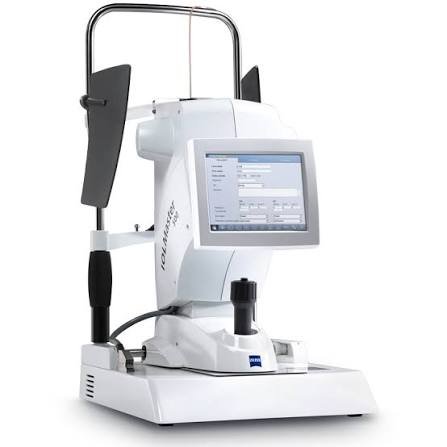
A recommendation is only as good as the measurement it rests on. These are the machines your findings come from.
 Prism bars and cover test set
Measures the exact angle of deviation in every gaze
Prism bars and cover test set
Measures the exact angle of deviation in every gaze
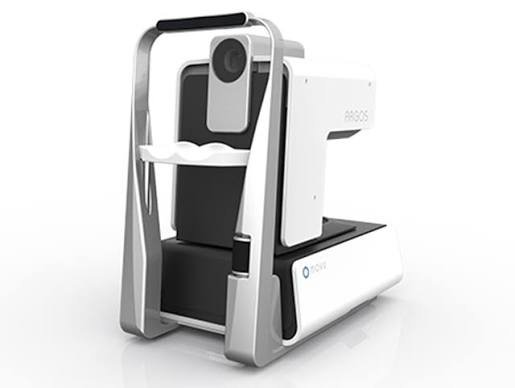 Computerised visual acuity system
Age-matched acuity testing for children and adults
Computerised visual acuity system
Age-matched acuity testing for children and adults
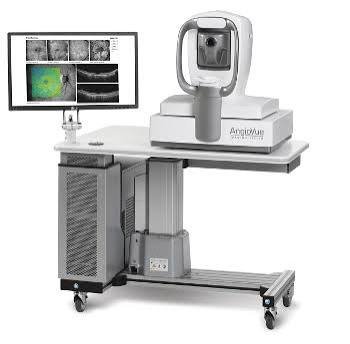 Hess chart and diplopia charting
Maps double vision and tracks nerve palsy recovery
Hess chart and diplopia charting
Maps double vision and tracks nerve palsy recovery
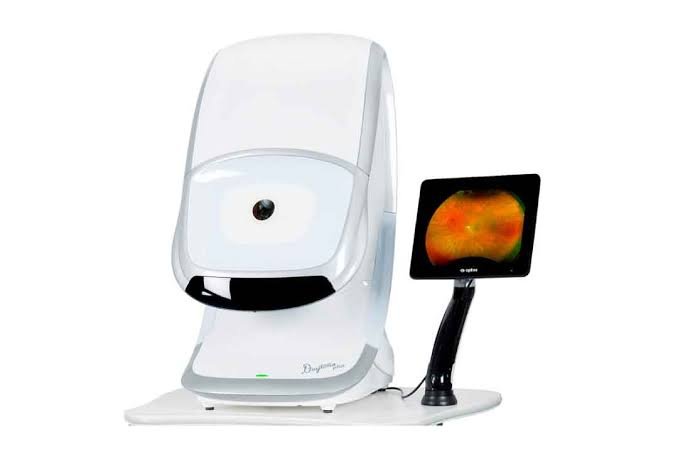 Synoptophore and stereopsis tests
Assesses fusion and depth perception before treatment
Synoptophore and stereopsis tests
Assesses fusion and depth perception before treatment
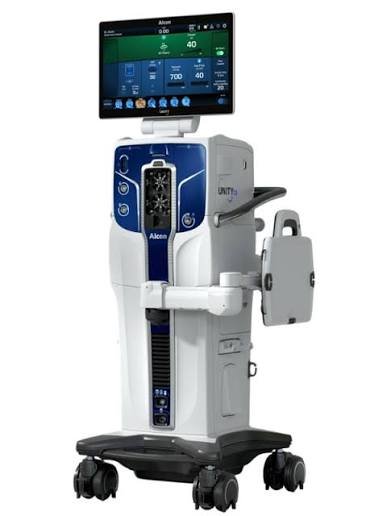 Zeiss operating microscope
Magnified, illuminated view for muscle surgery
Zeiss operating microscope
Magnified, illuminated view for muscle surgery
Step by step, from first visit to final review
No surprises. Here is exactly how this unfolds.
-
First consultation and orthoptic assessment
Around an hour. Vision in each eye, cover tests, prism measurements, motility and stereopsis, then a dilated examination of the retina and optic nerve to rule out a cause sitting inside the eye.
-
Cycloplegic refraction and a glasses trial
Dilating drops give the true power. If the squint is accommodative, glasses are prescribed and worn full time, and we reassess after about three months. Many children need nothing further than this.
-
Treating the lazy eye first
Where amblyopia is present, patching or atropine begins straight away with monthly reviews. Vision is brought up as far as it will go before surgery is planned, because that improves both the result and its stability.
-
Planning the operation
Measurements are repeated on at least two separate visits before anything is scheduled, since a single reading can mislead. You are told which muscles will be operated, on which eye, and what result is realistic, including the chance of needing a second sitting.
-
Surgery day
Day-care admission with fasting instructions given in advance. Thirty to forty-five minutes in theatre, general anaesthesia for children with a paediatric anaesthetist present, and home the same evening with drops and written instructions.
-
Follow-up and long-term review
Reviews at week one and week six, a glasses re-check at around six weeks, then six-monthly for two years. Squints can drift again years later, particularly in children, so we keep watching rather than discharging you at six weeks.
Why patients choose us for squint
A squint clinic for both children and adults
Adults with a long-standing turn are assessed on the same footing as children, not told it is too late or purely cosmetic.
Full orthoptic work-up before any surgery
Prism measurements repeated across visits, diplopia charting and stereopsis testing. Nobody is scheduled for theatre on one afternoon of readings.
1,35,000+ surgeries since 1993
Thirty-four years of operating experience across our five centres, with 30+ specialists and paediatric anaesthesia support.
NABH-accredited theatres
Independently audited sterilisation, anaesthesia and paediatric safety protocols at every centre.
Costs and insurance explained upfront
A written estimate before booking, and our insurance desk documents the functional findings that cashless approval for squint surgery depends on.
Consultants who handle squint
The same consultants practise across our centres — you get the specialist, not the postcode.
Where squint is available
Listed plainly so you do not travel to the wrong centre.
| Centre | Status | What is offered |
|---|---|---|
| Masab Tank, Hyderabad | Available | Adult and childhood squint surgery, adjustable sutures |
| KPHB, Kukatpally | Available | Squint assessment and surgery |
| Warangal | Available | Squint assessment and surgical planning |
| Nalgonda | Available | Squint assessment and management |
| Badvel, Kadapa | Referred | Squint surgery is performed at our Hyderabad centres |
Squint Treatment — your questions answered
Will my child outgrow a squint?
A constant turn will not go away on its own, and an eye that is still turning at four months of age needs to be examined rather than watched. Only the loose, occasional wandering seen in the first two to three months of life reliably settles by itself. Waiting through the years when the visual pathway is developing is what turns a treatable squint into a permanently lazy eye.
Is squint surgery safe for a young child?
Yes, and it is one of the commonest paediatric eye operations performed worldwide. The surgery is on the muscles outside the eyeball and takes thirty to forty-five minutes. The part that worries parents most is the general anaesthesia, which is administered by a paediatric anaesthetist after a fitness check, in an NABH-accredited theatre, with the child going home the same evening.
Will surgery also fix my child’s lazy eye?
No. Surgery changes where the eye points; it does not restore vision that never developed. Amblyopia is treated separately with the correct glasses and patching or atropine, usually before surgery and continuing afterwards. If anyone tells you an operation will improve the sight in a lazy eye, ask them to explain how.
Can a squint come back after surgery?
It can. A proportion of patients drift under- or over-corrected over months or years, particularly children operated very young and adults with thyroid eye disease or a nerve palsy. This is usually managed with glasses or prisms, and sometimes a second, smaller procedure. It is the reason we review for two years rather than discharging you at six weeks.
Is it ever too late to treat a squint?
For alignment, no. We operate on adults in their forties, fifties and sixties, including squints present since childhood, and the surgery is essentially the same. What does have a deadline is vision in a lazy eye and fine depth perception, both of which respond far better in childhood. So the honest answer is that the eye can be straightened at any age, while the sight cannot always be recovered at any age.
Is sudden double vision an emergency?
Yes. A squint or double vision that appears suddenly in an adult can signal a stroke, an aneurysm, raised pressure inside the head, a serious diabetic nerve palsy or trauma. Come in the same day, or go to any emergency department if you cannot reach us. Our 24×7 eye emergency line is +91 40-4245 6666. This is one of the few genuinely urgent presentations in eye care.
I have had a squint since childhood and I am now 45. Is correction just cosmetic?
It is not. Alignment surgery in adults can restore fusion and, in a meaningful proportion, some depth perception, and it widens the combined field of view. There is also a well-documented psychosocial benefit in employment and social interaction that is not vanity by any reasonable definition. Before operating we do a prism trial in clinic to check that straightening the eyes will not leave you with troublesome double vision.
How long is the recovery, and when can my child go back to school?
Most children are back at school in about a week, and adults with desk jobs in a similar time. The eye stays red, watery and gritty for two to four weeks and the redness can take six weeks to settle completely, which surprises people more than any discomfort does. Drops are used for four to six weeks, and swimming and dusty environments are avoided for a month.
Does insurance cover squint surgery?
Most policies cover it when it is documented as functional rather than cosmetic, which is why the record needs to show the measured deviation, any double vision, the field of view and the binocular findings. Paediatric squint surgery is generally covered; adult cases are approved more readily when the functional problem is clearly recorded. Our insurance desk handles pre-authorisation and gives you the exact out-of-pocket figure in writing before admission.
My baby’s eyes look crossed in photographs but the doctor says they are straight. Who is right?
Both, quite often. A broad nasal bridge and wide inner eyelid folds cover more of the white on the inner side and make a straight eye look turned in, particularly in flash photographs and when the baby looks sideways. This pseudosquint needs no treatment. A cover test settles the question in seconds, so it is still worth having it checked rather than assumed.
Often looked at alongside this
Paediatric Ophthalmology
Children rarely say their vision is poor — they adapt. We find what they will not tell you.
Learn moreComprehensive Ophthalmology
A full diagnostic examination that checks the whole eye — not just what prescription you need.
Learn moreOculoplasty
Ptosis correction, eyelid reconstruction, thyroid eye disease and blocked tear ducts — functional surgery around the eye.
Learn moreLASIK & Refractive Surgery
Freedom from glasses through LASIK, SILK, PRK, ICL or refractive lens exchange — matched to your cornea, not to a trend.
Learn moreGet the eye turn measured, not guessed
One assessment tells you whether it is a true squint, what is driving it, and whether glasses alone will straighten it. If no surgery is needed, we will say so plainly and tell you when to come back.