
Patients often try to book with a department. Retina, cornea, glaucoma. It is a reasonable instinct and it is usually wrong, because the symptom you notice and the tissue causing it are frequently in different places. Blurred vision can come from the tear film, the lens, the retina or the optic nerve, and you cannot tell which from the outside. Here is how the sorting actually works.
Why we start with the symptom, not the department
Take one complaint: "my vision has become blurred over the last few months." Depending on what the examination finds, that same sentence leads to four different departments.
- Blur that improves with a new spectacle power, and a lens that looks cloudy on the slit lamp: cataract.
- Blur that comes and goes with blinking, worse on screens and in air conditioning: ocular surface and dry eye, under cornea.
- Blur in the centre of the field with straight lines looking bent: macula, under retina.
- Blur that turns out to be lost peripheral field the patient never noticed: glaucoma.
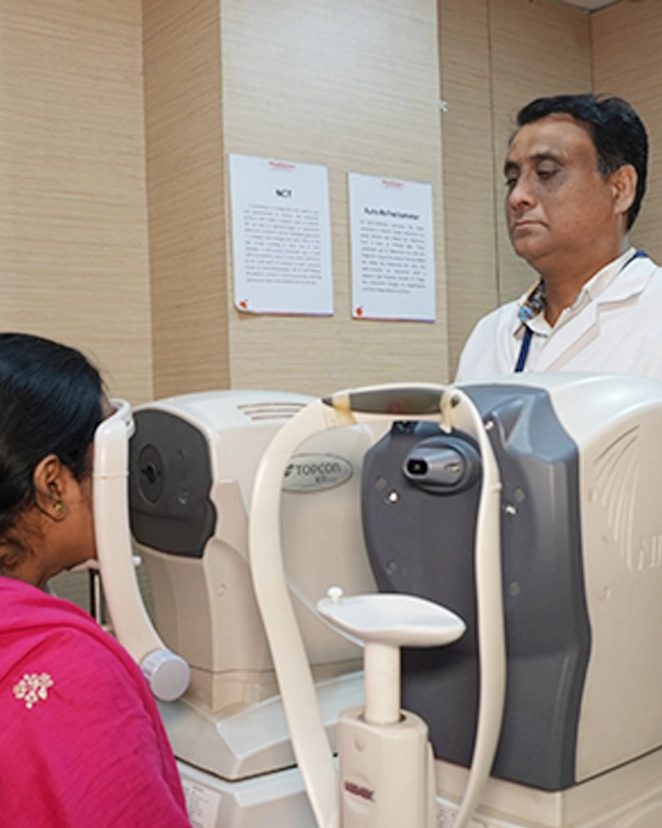
This is why a general consultation is not a lesser appointment. Vision, pressure, refraction and a slit lamp examination take about twenty minutes and settle the question. Only then does the referral to a subspeciality mean anything.
Symptoms that do point somewhere specific
Some complaints are informative enough that we can route them straight away when you book.
- Watering eye, sticky discharge, a lump on the eyelid, a drooping lid — oculoplasty. The lids and tear drainage system are a plumbing and mechanics problem, not an optical one.
- A child who squints, tilts their head, sits very close to the TV, or is struggling to read the blackboard — paediatric ophthalmology, and often squint services alongside.
- Adult double vision — squint and neuro-ophthalmology. New double vision in an adult always deserves prompt assessment, because a proportion of causes are neurological or vascular rather than muscular.
- Rapidly changing spectacle power in a teenager or young adult, especially with astigmatism — cornea, to rule out keratoconus. Cross-linking early can stop progression; nothing restores a cornea that has already thinned and steepened badly.
- Wanting to be free of glasses — refractive services, where the assessment decides between SILK, LASIK, surface ablation, a lens implant, or none of them.
- Diabetes, with or without symptoms — retina, annually, regardless of how good your vision feels.
The symptoms that mean today, not next week
A short list, and worth remembering rather than looking up.
- Sudden loss of vision in one eye, painless or otherwise.
- A sudden shower of new floaters, flashes of light, or a shadow or curtain moving across the field. This is how a retinal detachment announces itself, and the window where it is easiest to repair is measured in days.
- A severely painful red eye with haloes, headache and vomiting. Acute angle closure. Pressure is doing damage while you wait.
- Any chemical splash. Irrigate with clean water for at least fifteen minutes first, then come. The washing matters more than the travelling.
- Any injury with a sharp object, or an eye that will not open after trauma. Do not press on it, do not attempt to remove anything embedded.
- A painful red eye in a contact lens wearer. Remove the lens, keep it, and come the same day. Corneal infections in lens wearers can progress quickly.
Our Masab Tank flagship runs 24x7 emergency cover on +91 40-4245 6666. For anything on that list, go there rather than waiting for a convenient outpatient slot. The other centres will see you in working hours; details are on our emergency page.
When the answer is more than one speciality
Several common conditions genuinely sit across departments, and treating them in a single silo produces poor results.
Diabetes. The retina is the obvious concern, but diabetes also accelerates cataract, raises the risk of glaucoma and dries the ocular surface. A diabetic patient having cataract surgery needs the retina assessed first, because macular oedema present before surgery will worsen after it if left untreated.
High myopia. Beyond about minus six dioptres, the retina is thinner and the risks of tears, detachment and myopic macular changes are higher for life. That is true whether or not you ever have laser correction. High myopes need a dilated retinal examination at intervals, not just a spectacle check.
Thyroid eye disease. Sits between oculoplasty, squint and the endocrinologist. Lid position, eye movement, and pressure on the optic nerve all need watching, and the ophthalmic management depends on where the thyroid disease itself has got to.
Long-term steroid use. Steroid drops, tablets or inhalers can raise eye pressure and cause cataract. If you are on steroids for any reason, mention it, and get pressures checked.
In these cases the consultant who sees you first stays involved rather than handing you over. Continuity is not a courtesy here, it is how the picture stays coherent.
If you genuinely do not know
Book a general consultation. It is the cheapest and fastest way to get the right person. Bring your old glasses, current drops and any previous reports, and expect to be in the building for 90 minutes to two hours if dilation is needed.
Where you go also matters. KPHB runs until 8:30 pm and does SILK and LASIK. Warangal and Nalgonda are open seven days. Badvel handles government scheme surgery and does not do laser vision correction. Masab Tank does everything and never closes.
If you are still unsure which centre suits your problem, call +91 90001 80035 and describe the symptom rather than naming a department. That one sentence is usually enough for us to point you correctly.