
After the age of sixty, most people notice their eyes are not what they were. The difficulty is that ordinary ageing and serious disease can feel identical at the start. Both are gradual. Both are painless. Both get explained away as "just old age". The practical skill is knowing which changes can wait for a routine appointment and which ones cannot wait at all.
Symptoms that mean the same day, not next week
A small number of eye problems damage sight permanently within hours. If any of the following happens, treat it as an emergency and go to a hospital that can see you immediately.
- Sudden loss of vision in one eye, even if it comes back after a few minutes.
- A curtain or shadow spreading across part of your field of view.
- A sudden shower of floaters with flashes of light, especially in one eye.
- Severe eye pain with a red eye, headache, nausea and haloes around lights. This can be an acute glaucoma attack.
- Sudden double vision or a drooping eyelid appearing over hours.
- Any injury where something has struck or entered the eye.
None of these improve by waiting. A retinal detachment treated on day one usually does better than the same detachment treated on day five. Our Masab Tank centre runs a 24x7 eye emergency service for exactly this reason. If you are unsure whether what you have counts, call. A phone call costs nothing and we would far rather rule something out.
Gradual changes that still deserve an appointment
These are not emergencies, but none of them should be absorbed into daily life without an explanation:
- Glare from oncoming headlights that makes night driving unpleasant or frightening.
- Colours looking washed out or yellowish, particularly if one eye seems duller than the other.
- Needing more light than you used to for reading, or changing your spectacle power more than once in a year.
- Straight lines looking bent or wavy: a door frame, a tiled floor, the edge of a page.
- A blurred or missing patch in the centre of your vision when you look straight at a face.
- Bumping into furniture or missing steps, which often means the side vision has narrowed without you noticing.
The last two matter most. Central distortion suggests something is happening at the macula. Quietly shrinking side vision is the classic pattern of glaucoma, which causes no pain and no early symptom at all.
What is usually behind it
Four conditions account for the large majority of sight loss in older adults in India, and all four are manageable if found early enough.
Cataract
The natural lens hardens and clouds with age. Vision dims, glare increases, and spectacle powers drift. Cataract is the one on this list that is fully reversible. Modern cataract surgery is a day procedure, usually under drops, and the lens implant is chosen to suit how you actually use your eyes. There is no medical benefit in waiting until a cataract is "ripe" or "mature"; that old advice belongs to an era of different surgical techniques, and a very hard cataract is a more difficult operation.
Glaucoma
Pressure damage to the optic nerve. It takes the peripheral field first and the centre last, which is why people often reach us only when a good part of the nerve is already gone. Nothing lost to glaucoma can be recovered. What treatment does, reliably, is stop further loss. Drops, laser and surgery all work by lowering pressure, and most patients need lifelong follow-up rather than a cure.
Diabetic retinopathy
If you have had diabetes for ten years or more, the retina is almost certainly involved to some degree, whether or not your vision has changed. Bleeding and swelling at the macula can be treated with injections and laser, but only if it is found before the retina scars. Anyone with diabetes needs a dilated retina examination once a year, symptoms or no symptoms. This is the single most useful appointment a diabetic patient can keep.
Age-related macular degeneration
The macula is the small central part of the retina that reads faces and text. In the dry form it thins slowly. In the wet form, abnormal vessels leak and vision can drop within weeks, and that form responds well to injections started early. The waviness in straight lines mentioned above is often the first sign.
What a proper examination should include
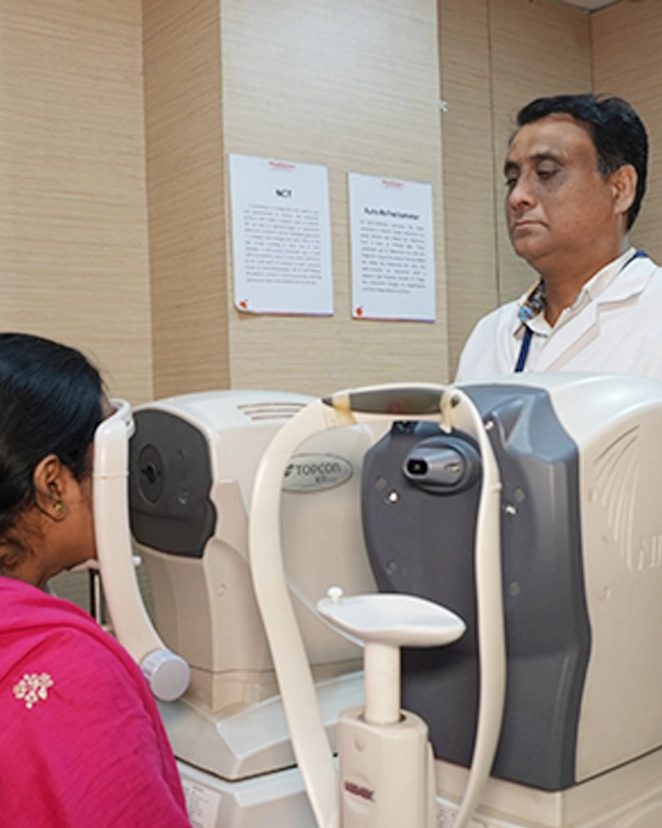
A vision test at an optical shop measures spectacle power. It does not look at the optic nerve, the macula or the eye pressure. For anyone over sixty, a complete check should cover vision with and without glasses, eye pressure, the front of the eye on a slit lamp, and a dilated look at the retina. Dilation means drops that blur your near vision for four to six hours, so bring someone along and do not plan to drive back.
Depending on what is found, the doctor may add an OCT scan of the macula and optic nerve, a widefield retinal photograph, or a visual field test. These are not routine add-ons for everybody. They answer specific questions, and you are entitled to ask which question yours is answering.
For a healthy adult over sixty with no complaints, once a year is a sensible interval. With diabetes, glaucoma in the family, high myopia or previous eye surgery, your doctor will usually want to see you more often. Our comprehensive eye care service is built around this kind of periodic review rather than one-off visits.
A note on what treatment can and cannot do
Being honest about this saves a lot of disappointment. Cataract surgery restores vision. Glaucoma treatment protects what is left. Retinal injections often stabilise vision and sometimes improve it, but they do not turn the clock back. If someone promises you that an advanced procedure will return the sight you had at forty, be sceptical.
Where vision cannot be restored, a good deal can still be done with magnifiers, better lighting, high-contrast household changes and low-vision aids. That conversation is worth having rather than accepting that nothing more is possible.
If a parent or grandparent has been quietly managing with less sight for a while, the useful next step is simply a dilated examination with someone who will explain the findings in plain language. Our centres across Hyderabad, Warangal, Nalgonda and Badvel all offer this, and you can find the nearest one on our branches page or call +91 90001 80035 to book a time that suits.