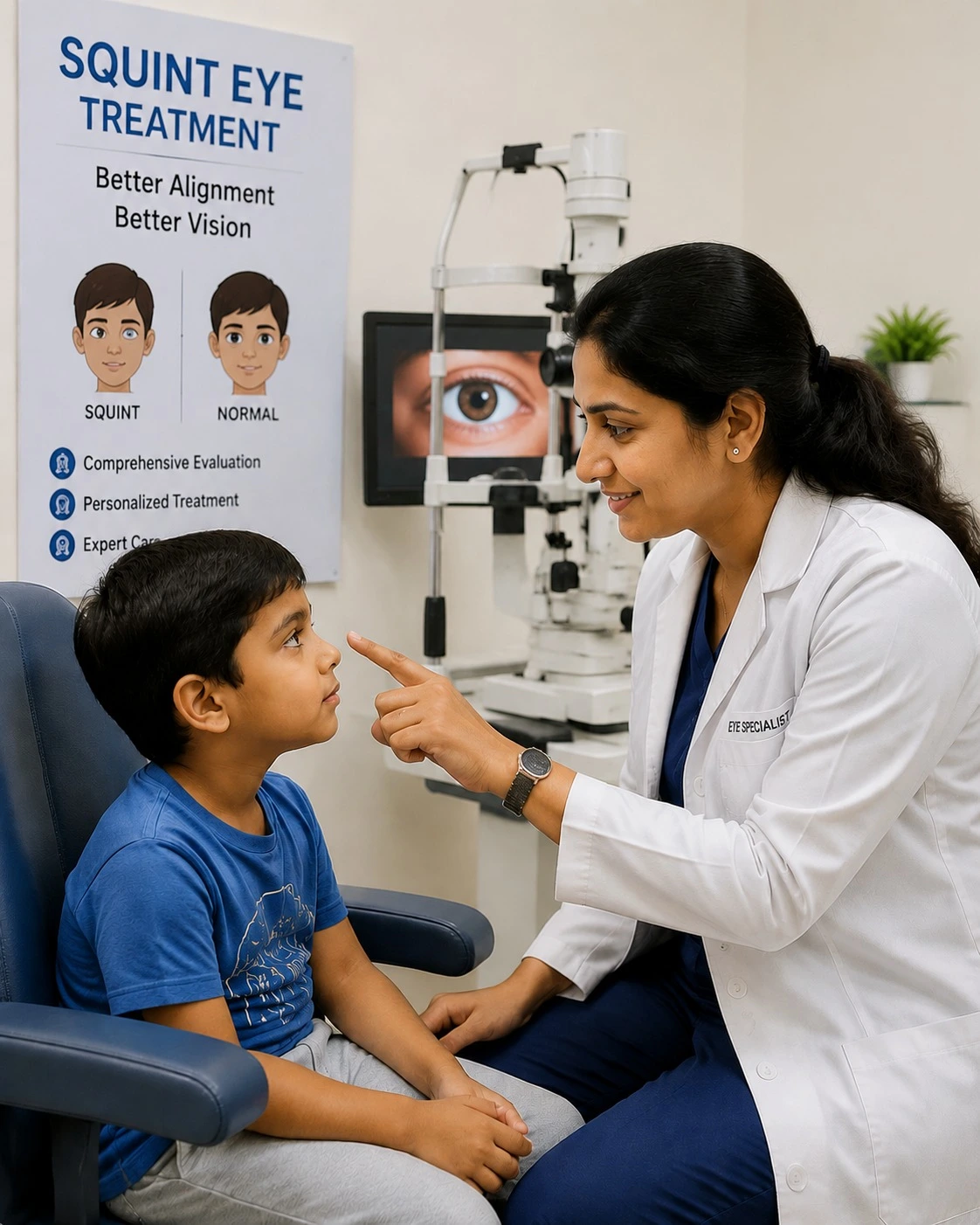

A child with poor vision in one eye almost never says so. They have no idea anything is wrong. Whatever they see is simply what seeing is, and the good eye covers for the weak one so smoothly that a family can go years without noticing. That is the central problem in children's eye care: the child is not the one who reports it. Somebody else has to spot it.
Here are the six we find late most often, and what tends to give each one away.
1. Amblyopia, the lazy eye
One eye is blurred, so the brain quietly stops using it. The eye is healthy. The wiring between eye and brain simply never developed properly, usually because of an uncorrected spectacle power on that side or a squint.
The reason this one is urgent is that the window for treatment closes. Visual development is largely done by about eight years of age. Found at four, amblyopia usually responds well to glasses and patching. Found at twelve, much of the loss is permanent, and there is no operation, drop or spectacle that recovers it later.
What gives it away: often nothing at all, which is why routine screening exists. Sometimes a child covers or closes one eye, or a school screening finds different vision in each eye.
2. Intermittent squint
Constant squint gets noticed. Intermittent squint often does not, because it appears only when the child is tired, unwell, daydreaming or in bright sunlight, and disappears the moment you look properly.
Parents frequently report it and are told the eyes look straight in the clinic, which is entirely possible and does not mean the parent was wrong. If you have seen it, take a photograph or short video on your phone and bring it. That evidence changes the examination.
What gives it away: one eye drifting out in bright light, closing one eye in the sun, a phone photo where the light reflex sits off-centre in one pupil.
3. Long-sightedness that hides in plain sight
Short-sighted children get found because they cannot read the blackboard. Long-sighted children are missed because their distance vision is fine. A child's focusing muscle is strong enough to compensate for a substantial hypermetropic power — but compensating all day is tiring.
The result looks like a behaviour problem rather than an eye problem: avoids reading, loses concentration after fifteen minutes of homework, complains of headache in the evening, rubs the eyes. Untreated, it is also the commonest cause of an inward squint in a young child.
What gives it away: reluctance to read, evening headaches, a school report that says the child is bright but does not apply themselves.
4. Myopia that is progressing fast
Finding short-sightedness is easy. What gets missed is the rate at which it is increasing. A child moving from minus 1.00 to minus 2.50 in eighteen months is on a different track from one whose power is stable, and that track matters, because high myopia in adulthood carries a real, lifelong risk of retinal problems.
Progression is only visible if someone is recording the numbers consistently and comparing them. That is an argument for annual, documented refraction rather than a new prescription from wherever is convenient each time.
What gives it away: a new spectacle power every year, moving closer to the screen, squeezing the eyes shut to see distance.
5. Blocked tear duct in infants
A baby whose eye waters constantly and gathers sticky discharge, usually on one side, is often treated with repeated courses of antibiotic drops. The drops clear the discharge, it comes back, and the cycle repeats. The actual problem is usually a tear drainage passage that has not opened.
Most open on their own in the first year, helped by correct massage over the tear sac, which takes two minutes to demonstrate and is worth learning properly. If it has not settled by around a year, a short probing procedure resolves the majority. Persistent watering in an infant should be examined rather than repeatedly medicated — occasionally, watering is a sign of raised eye pressure, which is a different and far more serious matter. Our oculoplasty team handles tear duct problems in children.
What gives it away: watering from one eye since the first weeks of life, sticky lashes in the morning, discharge that returns each time drops are stopped.
6. Convergence insufficiency in older children
A teenager with perfect 6/6 vision who cannot read for more than twenty minutes without words swimming, doubling or blurring may have a problem holding the two eyes converged at near. Vision testing at distance is completely normal, so this gets dismissed as poor concentration or exam anxiety.
It is diagnosed with a specific near-vision assessment and treated with structured exercises, sometimes with a reading prism. It responds well when identified. Screen-heavy study routines make the symptoms worse, so the timing around exams is not a coincidence.
What gives it away: words moving or doubling while reading, losing the line, eye ache after study, better with audio than text.
What to do with this list
Do not turn it into a diagnostic exercise at home. The useful action is simpler: a full dilated eye examination at around three years of age, another before starting school, and then whenever something on this page sounds familiar. Dilation matters, because without it a child's focusing muscle can conceal the very power that is causing the trouble.
Take that phone video if you have one. Bring old prescriptions if there are any, even scraps of paper from an optical shop, because the sequence of numbers over time is genuinely useful information.
MediVision runs paediatric eye clinics at Masab Tank and KPHB, with children also seen at our Warangal, Nalgonda and Badvel centres. You can read more about what we do on the paediatric page, or call +91 90001 80035 to arrange a proper examination with time set aside for dilation.