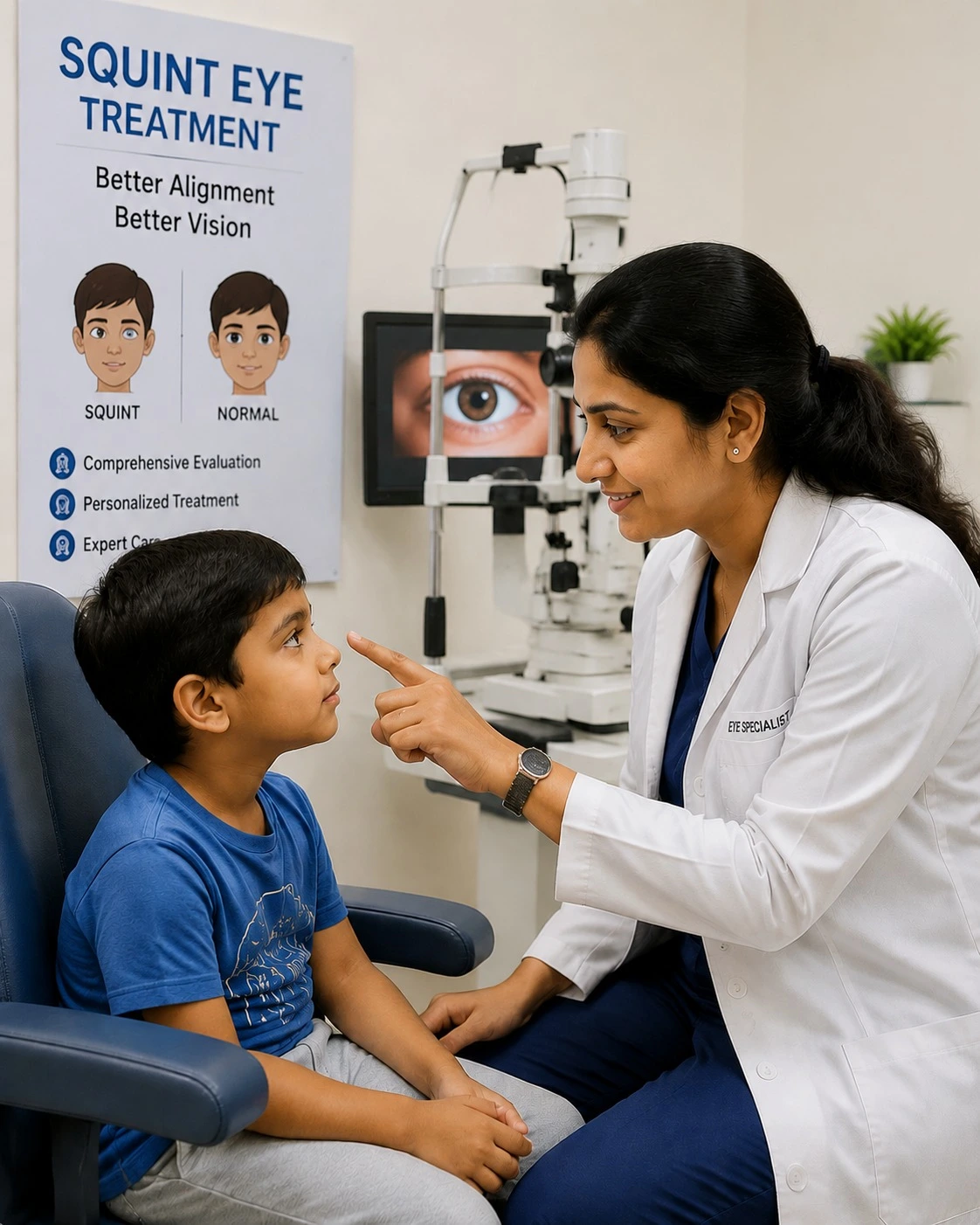
A squint in a child is not a cosmetic problem. It is a vision problem that happens to be visible, and treating it late costs the child sight that cannot be recovered later. That is the single most important thing to understand, because the most common advice families are still given is to wait and see whether the child grows out of it. Beyond the first four months of life, children do not grow out of a squint.
What is actually going wrong
Both eyes normally point at the same object. The brain receives two slightly different images and fuses them into one, which is what gives you depth perception. In a squint, one eye points somewhere else, so the brain receives two images it cannot merge.
An adult brain in that situation reports double vision. A young brain does something else entirely: it suppresses the image from the deviating eye. The double vision disappears, the child seems comfortable, and everybody relaxes. But the suppressed eye stops developing. That is amblyopia, or lazy eye, and it is the real damage a squint causes. The visible turn is only the sign.
Squints have several causes, and they are worth separating because they lead to different treatment:
- Refractive. A strongly long-sighted child has to over-focus to see clearly, and focusing drags the eyes inward. The eye turns in because of the spectacle power, not because of a muscle fault.
- Muscle imbalance. The six muscles around each eye are unequal in strength or attachment, and the eye sits off centre.
- Nerve palsy. A nerve controlling one muscle is weak, so the eye cannot move fully in one direction. In adults this is often the first sign of diabetes, high blood pressure or a stroke.
- Secondary to poor vision in one eye. An eye that cannot see, because of a congenital cataract, corneal scar or retinal problem, tends to drift. Here the squint is the symptom, not the disease, which is why every squint assessment includes a dilated examination of the back of the eye.
Why the age it starts changes the plan
The visual system finishes wiring itself somewhere around seven or eight years of age. Before that, it is plastic: a weak eye can be pushed to catch up. After that, the window closes, and vision lost to amblyopia usually stays lost.
So the same finding means different things at different ages. A four-year-old with an inward turn and a weak eye has a good chance of ending up with two eyes that see well and work together. A twelve-year-old with the identical history can have the alignment corrected, but the weak eye will probably not gain much vision. Straight eyes, yes. Full sight in both, usually not.
This is why we ask parents to bring in a child with any constant eye turn after four months of age, and any intermittent turn that is getting more frequent, without waiting for a school screening. It is also why our paediatric department spends more time on vision testing than on the turn itself.
The treatment ladder, in order
Surgery is not the first step and often not needed at all. Treatment follows a sequence, and each rung is tried properly before moving up.
- Glasses. A full dilated refraction comes first, always. In accommodative squint, the correct spectacle power straightens the eyes completely, and the turn returns the moment the glasses come off. Operating on that child would be a mistake. A meaningful number of childhood squints need nothing beyond the right prescription, worn full time.
- Treating the lazy eye. If one eye is weaker, it is strengthened before any alignment surgery, usually by patching the strong eye for a set number of hours daily, or by blurring it with atropine drops. This part depends almost entirely on the family. It is tedious, the child resists, and it works only if it is done consistently for months.
- Prisms. For small deviations and for adults with double vision, a prism ground into the spectacle lens shifts the image so the two eyes can fuse. Useful, non-invasive, and limited to smaller angles.
- Exercises. Genuinely helpful for one specific condition, convergence insufficiency, where the eyes struggle to turn inward for reading. Not a substitute for surgery in other types, whatever you may read online.
- Surgery. When a real deviation remains after glasses and amblyopia treatment, the muscles are adjusted to bring the eyes into line. This corrects position. It does not improve the vision of an amblyopic eye, which is why it comes after patching and not instead of it.
Adults with squint
Adults are routinely told that nothing can be done because they are past the age. That is wrong, and it keeps people with a lifelong turn from getting a straightforward operation.
Adult squint surgery is done under local or general anaesthesia as a day procedure, and it works well for alignment. What differs from childhood surgery is the honest expectation. If the eye has been amblyopic since childhood, its vision will not improve. Depth perception may or may not return, depending on whether the brain ever learned to fuse. What does reliably improve is the position of the eyes, and for many adults, the ability to hold a gaze during a conversation or an interview matters a great deal.
One adult presentation is urgent rather than elective. A squint or double vision that appears suddenly, over hours or days, particularly with headache, drooping lid or unequal pupils, needs same-day assessment. That is a nerve problem until proved otherwise, and the cause sits outside the eye. Our emergency service at Masab Tank runs 24 hours for exactly this kind of thing.
What treatment cannot promise
Three limitations, stated plainly, because they come up after surgery more often than before it.
- Alignment is measured in degrees, not achieved perfectly. A small residual turn is a good result, not a failure. A proportion of patients need a second procedure months or years later, and that is planned for rather than unexpected.
- Some children still need their glasses after surgery. Surgery corrects the deviation that glasses could not, not the refractive error itself.
- A squint can recur, particularly in children operated very young, and particularly if the underlying refractive error is not corrected consistently. Follow-up is not optional.
If you have noticed a turn in your child's eyes, or a photograph keeps showing one eye pointing differently, book a full assessment rather than a quick vision check. It takes about ninety minutes with dilating drops and tells you which rung of the ladder you are on. You can read more on our squint treatment page, or come to our KPHB centre, which runs until 8:30pm for families who cannot manage a daytime appointment.