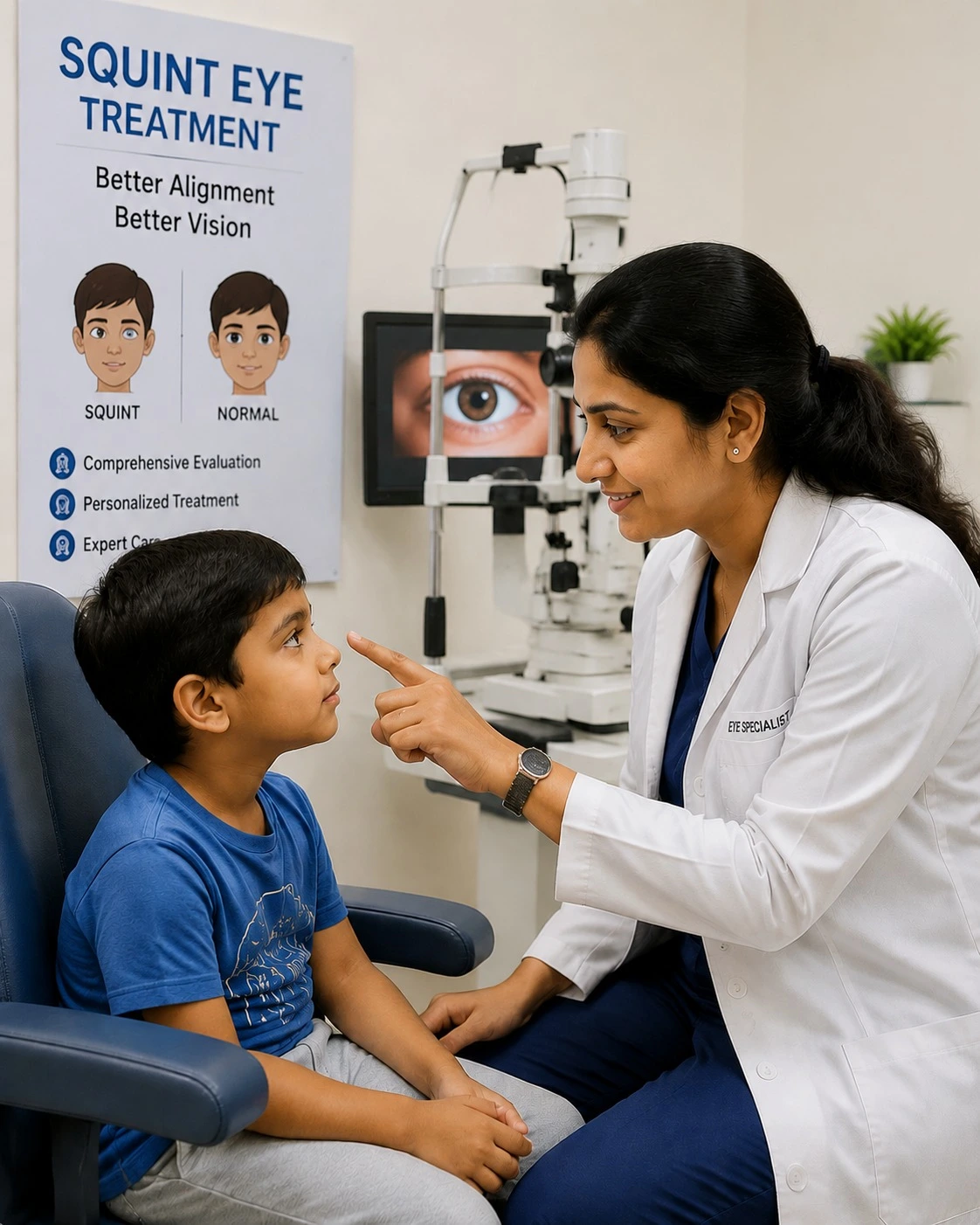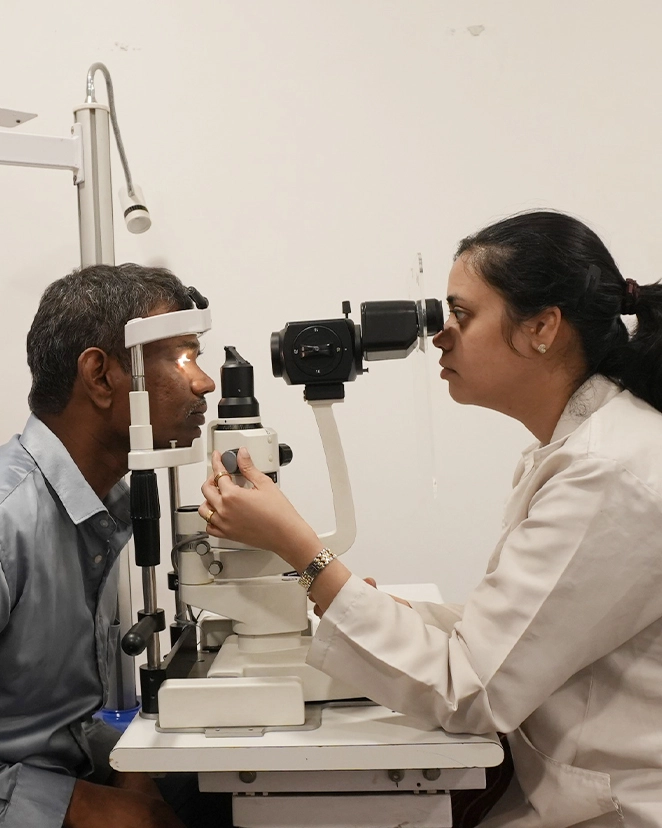

Squint surgery adjusts the muscles attached to the outside wall of the eye. The eye is not removed from the socket at any point, nothing is done inside the eye, and vision is not touched. Almost every anxious question families ask before the day comes down to one of those three misconceptions, so it is worth clearing them at the start.
What follows is the actual sequence, in the order you will experience it.
Before the date: the measurements decide everything
The operation is planned in the clinic, not in the theatre. The surgeon needs to know how far the eye deviates, and that number changes with distance, direction of gaze and which eye is doing the looking. So the assessment is longer than most patients expect.
It includes vision in each eye separately, a dilated refraction, cover testing at distance and near, prism measurements in several directions of gaze, an assessment of how well each muscle moves, and a look at the retina and optic nerve. In children we usually want two sets of measurements on separate days before finalising the plan, because a single reading on a restless afternoon is not reliable enough to operate on.
From those numbers the surgeon decides which muscles to work on and by how many millimetres. A muscle can be weakened by detaching it and reattaching it slightly further back, or strengthened by shortening it. One eye or both may be operated depending on the pattern. If someone quotes you a plan without having done prism measurements, ask why.
The other thing settled beforehand is anaesthesia. Children have general anaesthesia, which means a paediatric fitness check, a blood test and clear instructions on fasting. Adults can often have the surgery under local anaesthesia, awake, which avoids the fasting and the grogginess.
The day itself
Come fasting as instructed. For a child that usually means no solid food for six hours and clear fluids stopped two hours before, but follow the exact timing the anaesthetist gives you rather than a general rule. Bring the glasses, the previous prescriptions and any earlier records.
In theatre, the eyelids are held open with a small clip. The surgeon opens the thin transparent membrane covering the white of the eye, finds the muscle underneath, and repositions it with dissolving sutures. The membrane is closed with sutures that also dissolve. Nothing is left that needs removing later.
The operation takes roughly thirty to forty-five minutes for one eye and a little longer for two. An eye patch may or may not be applied. Most patients go home the same day, a few hours after waking, once the anaesthetist is satisfied. At our Masab Tank hospital the paediatric cases are scheduled first on the list so that children fast for the shortest possible time.
The first week, honestly described
The first twenty-four hours are the worst of it, and they are usually described as a gritty, scratchy sensation rather than pain. Paracetamol handles it in most cases. A child who is inconsolable, or an adult with genuine deep pain rather than surface irritation, should be seen rather than medicated at home.
What to expect over the week:
- Redness. The operated area looks alarming. Bright red, sometimes with a patch of blood under the surface. This is expected. It fades over three to six weeks, and in some adults takes up to three months to disappear completely.
- Swelling and watering. Both settle within a few days.
- Drops. An antibiotic and a steroid drop, tapering over four to six weeks. Space them five minutes apart and keep to the schedule, because the steroid taper is what keeps the eye quiet.
- Activity. Children go back to school after about a week. No swimming for a month, no dusty play areas, no rubbing. Adults doing desk work usually return within four to seven days.
- Double vision. Common in adults for the first days to weeks while the brain adapts to the new eye position. It usually settles. In a small number it persists and needs a prism, which is why adults are counselled about this specifically before surgery.
Weeks two to twelve, and what counts as success
The eye position on day one is not the final answer. Muscles settle, swelling resolves, and the alignment shifts slightly over six to twelve weeks. Judging the result before that is premature, and it causes needless worry in the second week when one eye looks slightly off.
Success in squint surgery is defined as alignment within a small measured range of straight, not as mathematical perfection. A residual deviation too small to be obvious in conversation is a good outcome. Roughly speaking, a proportion of patients across all squint types need a second procedure at some point, either because the correction settled short of target or because the deviation recurred years later. That is a known feature of this operation, not a sign that something went wrong, and it is discussed before surgery rather than after.
Two things surgery does not do. It does not improve the vision of an amblyopic eye, which is why patching is completed first. And it does not remove the need for glasses if there is an underlying refractive error, since the glasses were correcting focus, not position. Children usually continue in their spectacles afterwards, and stopping them can bring the turn back.
The risks worth knowing
Squint surgery is one of the safer eye operations, but no operation is free of risk and you should hear the list before consenting rather than read it on a form.
- Undercorrection or overcorrection, the commonest issue, sometimes needing a further procedure.
- Persistent double vision, mainly a concern in adults with long-standing squints.
- Infection, which is uncommon and treatable when reported early. Increasing pain, thick discharge or falling vision after the third day means the same day, not the next appointment.
- A slipped or lost muscle, rare, needing prompt repair.
- Scleral perforation, rare, since the wall of the eye is thin where the muscles attach.
- Anaesthetic risk, small but real in young children, which is why the pre-operative fitness check matters.
If squint surgery has been recommended for you or your child, ask what the measured deviation is, which muscles are planned, and what result the surgeon expects. Those three answers tell you a great deal about how carefully the case has been worked up. Our squint service covers assessment and surgery for both children and adults, and you can reach the team through the contact page or on +91 90001 80035 if you want to talk it through before booking.