
When we ask people why they returned to us, or why they sent a parent or a colleague, almost nobody mentions a machine. The answers are smaller and more human than that. After 34 years and more than 6,25,000 patients across our five centres, a few themes come up again and again. Some of them are compliments. Some of them are complaints. Both are worth writing down honestly.
"You told me I did not need surgery"
This is by far the most common thing people say, and it says something uncomfortable about the wider market. A patient comes in braced for a bill. They leave with a review date six months away and nothing else.
A large share of consultations end this way, and they should. Consider what actually walks through the door:
- Early cataract. A lens change visible on examination but not yet affecting daily life. Removing it early does not preserve anything. It just moves the surgery forward by a few years.
- Floaters. Most are age-related changes in the vitreous gel. Annoying, harmless, and no treatment is better than the condition. What we do is examine the retina carefully once, to make sure there is no tear behind them.
- Dry eye mistaken for a power change. Vision that blurs and clears when you blink is usually a tear film problem, not a spectacle problem. A new pair of glasses will not fix it.
- Mild refractive error in a child. Not every small number needs a prescription. Some need only a review in six months.
The honesty cuts both ways, though. We also tell people that surgery is needed sooner than they hoped, that a squint will not correct itself, or that the vision already lost to glaucoma is not coming back. If we only delivered the good version of honesty, it would not be honesty.
Seeing the same doctor the second time
Eye care is rarely one visit. Cataract means a consultation, a surgery and at least two follow-ups. Glaucoma means a lifetime of pressure checks and field tests where the whole point is comparison with last year's result. Diabetic retinopathy means scans that only mean something when read against the previous scan.
Patients notice when the person reading those results is the person who ordered them. When you book, you can ask for a specific consultant by name rather than the next available slot, and for chronic conditions we would encourage that even if it means waiting a few extra days. You can see who works where on our doctors page.
Where continuity genuinely matters, we say so. For a one-off red eye or a spectacle check, it does not, and you should take whichever slot is convenient.
Being told the cost before it happens
The second most common piece of feedback is about money, and it is usually about surprise rather than amount. People plan for a number. What upsets them is a different number appearing on the day.
So we try to say plainly what drives the price. In cataract surgery, the single biggest variable is the intraocular lens. A standard monofocal lens and a premium trifocal or toric lens can differ by several times over, and the surgery itself is largely the same operation. In laser vision correction, the variable is the procedure: surface ablation, LASIK and SILK sit in different bands, and your cornea often decides which of them you are eligible for, not your budget.
Two things we insist on:
- You get a written estimate before you commit, with the lens or procedure named on it.
- If a premium option would genuinely not help you, we say so. A multifocal lens in an eye with significant macular disease is money spent on a result you will not see.
At our Badvel centre a good proportion of surgery runs through government schemes, and the counselling desk there handles that paperwork as routine.
Waiting time, described accurately
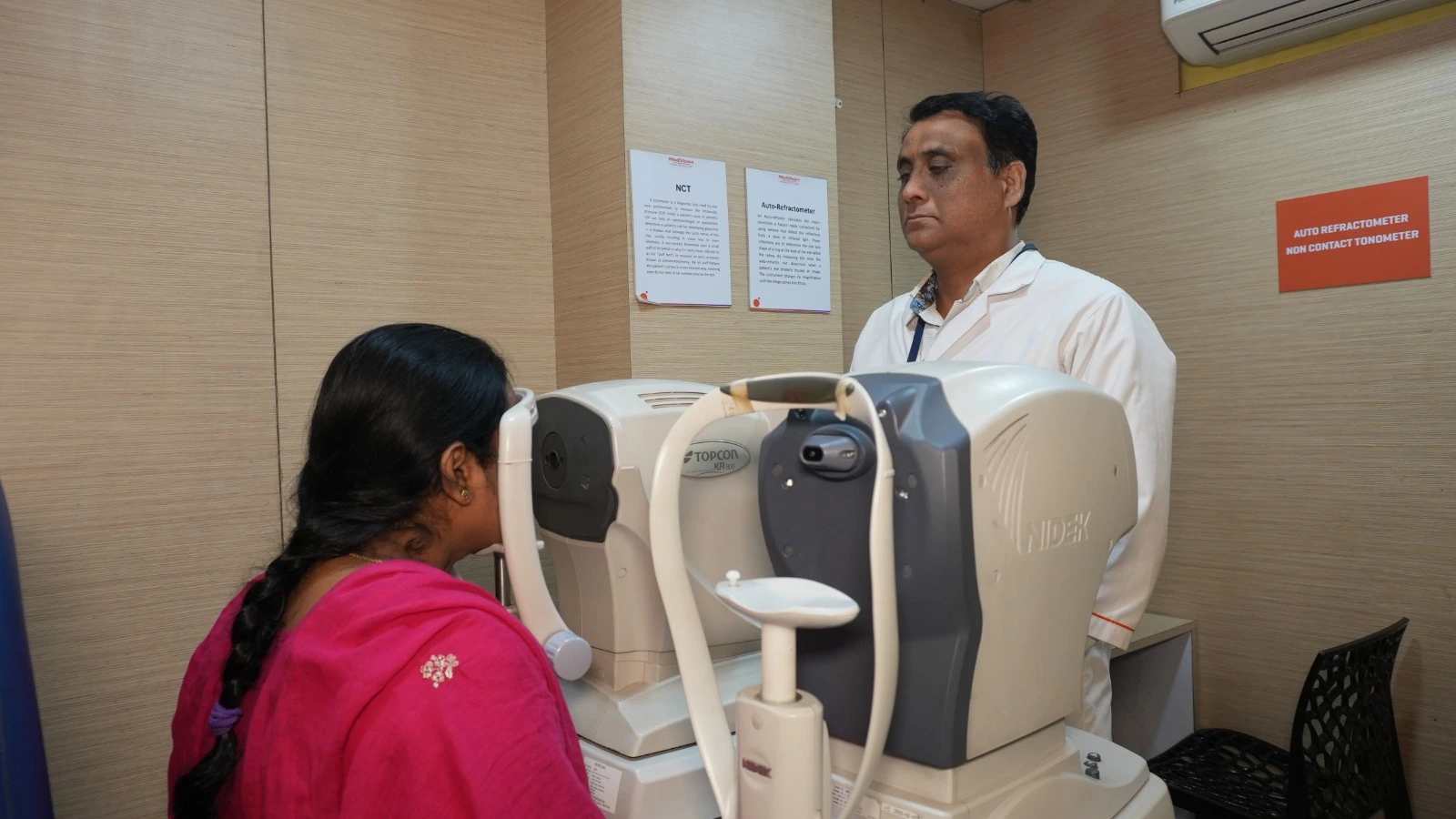
A first full eye examination takes longer than most people expect, and we would rather you knew that in advance than sat in the waiting area feeling misled. Dilating drops alone need 30 to 45 minutes to work. Add vision testing, pressure measurement, refraction, the doctor's examination and any scans, and a thorough first visit runs 90 minutes to two hours.
Practical things that help:
- Bring dark glasses. Everything is bright and blurry for four to six hours after dilation.
- Do not plan to drive yourself home from a dilated appointment.
- Bring your old spectacles, your current eye drops, and your sugar and blood pressure records if you have diabetes or hypertension.
- Our KPHB centre runs until 8:30 pm, which suits people who cannot take a working day off. Late evening is usually quieter than late morning.
What people tell us we could do better
Three complaints repeat often enough that they deserve a place here rather than a quiet corner.
Peak-hour crowding at Masab Tank. Our flagship carries every speciality plus 24x7 emergency cover, and mid-morning on a weekday it is busy. If your problem is routine, one of the other centres will get you seen faster.
Phone lines. At peak times the reception number is engaged. Online booking through our website is faster and it also lets you pick the doctor, which the phone queue often cannot.
Explaining scans. An OCT image is a strange-looking thing and a rushed explanation of it leaves people more worried than before. If a report has been shown to you and you did not follow it, please say so and ask again. Nobody in our consulting rooms minds explaining something twice.
If any of this sounds like the kind of care you want, book a consultation at whichever of our centres is nearest, or call and ask what a first visit would involve for your particular problem. You can find addresses and timings on our contact page.