The honest answer is that it depends on your age and on two or three specific risk factors, and for a healthy adult in their thirties it is less often than most clinics suggest. Here is the practical version.
The schedule, by age
Assume no symptoms and no known eye disease. If any of the risk factors in the next section apply to you, ignore this list and follow that one instead.
- Newborn to 3 years: a check at birth, and again at around six months if anything looks off to the paediatrician or to you. A white reflex in a photograph, an eye that drifts, or a persistently watering eye needs looking at immediately, not at the next milestone.
- 3 to 5 years: one full examination before starting school. This is the single most valuable eye test in a person's life, because lazy eye (amblyopia) is treatable at this age and largely untreatable after about eight. A child with one weak eye behaves completely normally, since the good eye compensates. You will not spot it at home.
- 6 to 18 years: every one to two years. Myopia in school-age children in Indian cities is rising fast and it progresses in steps, often noticed only when a child stops copying from the board. If your child already wears glasses, six-monthly checks are reasonable while the power is climbing.
- 18 to 40 years: every two to three years if you are healthy, see well and have no family history. Sooner if screens are causing persistent strain or headaches, or if your glasses no longer feel right.
- 40 to 60 years: every two years. Around 40 to 45 the near vision changes and everyone notices. The more important reason is that this is when glaucoma and early diabetic changes begin appearing, both of which are silent.
- Over 60: every year. Cataract, macular degeneration and glaucoma all cluster here, and annual testing at this stage is genuinely worth it.
Who needs checking more often, regardless of age
These override everything above.
- Diabetes: a dilated retinal examination every single year from the day of diagnosis, and more often if changes have already started. This is not negotiable. You can have significant diabetic retinopathy with 6/6 vision, because the damage starts away from the centre of the retina. By the time vision blurs, the treatment has become harder and the recovery less complete.
- Family history of glaucoma: annual checks from age 35. A parent or sibling with glaucoma raises your own risk several times over. The disease takes peripheral vision first, slowly, and the brain fills in the missing area so convincingly that most patients notice nothing until well past half the optic nerve is gone. That loss does not come back.
- High myopia, beyond about -6: annual retinal examination. A long eye has a stretched, thinner retina and a higher lifetime risk of retinal tears and detachment.
- Previous eye surgery or injury: follow whatever schedule your surgeon set, not a general rule.
- Long-term steroid use, including inhalers and skin creams used for months: steroids raise eye pressure in a proportion of people, and cause cataracts. Six-monthly pressure checks are sensible.
- Thyroid disease, rheumatoid arthritis and similar autoimmune conditions: these affect the eye directly, and some of the drugs used to treat them do too. Ask your physician what schedule applies to your medication.
When to come in now, not at your next check
Some symptoms are not scheduling questions. Go to an eye casualty the same day for any of these:
- Sudden loss of vision in one eye, even briefly
- A curtain or shadow moving across part of your vision
- A sudden shower of new floaters, especially with flashes of light
- Severe eye pain with redness, haloes around lights and vomiting
- Double vision that has come on suddenly
- Any chemical splash, which needs washing with water for fifteen minutes before you travel
- An injury with something that may have entered the eye
Our Masab Tank centre runs a 24x7 eye emergency desk on 040-4245 6666. Retinal detachment and acute glaucoma are both treatable and both time-sensitive. Waiting until morning is a genuinely bad trade.
What a proper examination should include
A refraction alone is not an eye test. It tells you what glasses you need and almost nothing about the health of the eye. A complete examination should cover:
- Vision measured for distance and near, each eye separately
- Refraction to determine the correct spectacle power
- Slit lamp examination of the front of the eye: cornea, lens, tear film
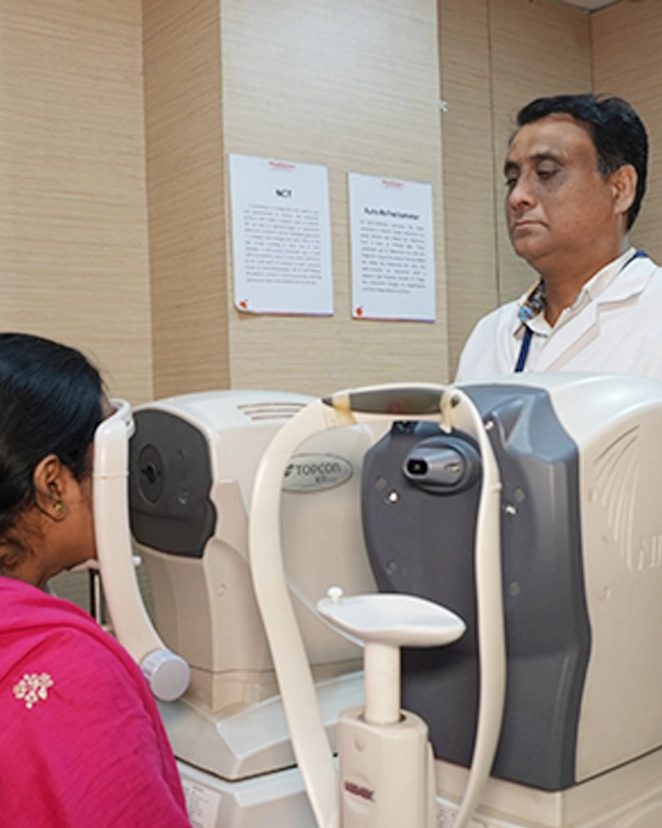
- Intraocular pressure measurement
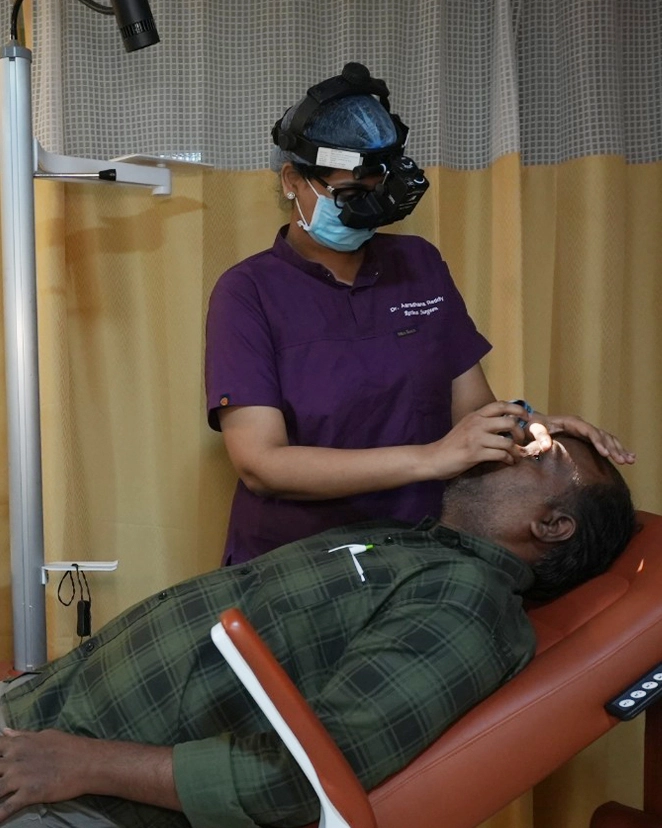
- A dilated look at the retina and optic nerve
The dilation is the part people try to skip because it blurs your near vision for a few hours and makes you light-sensitive. It is also the part that finds the problems worth finding. Bring sunglasses and arrange not to drive. If a checkup took fifteen minutes and your pupils were never dilated, you had a spectacle test, not an eye examination.
Where over-testing starts
To be even-handed about it: a healthy 30-year-old with stable vision, no diabetes and no family history does not need an annual eye test, and does not need an OCT scan every visit. Scans have a purpose. They establish a baseline where there is a reason to suspect something, and they track change over time in a known condition. Repeating them yearly on a normal eye with no risk factors adds cost and occasionally adds anxiety over findings of no consequence.
If a scan is being recommended, it is fair to ask what question it is meant to answer and what would change if the result came back normal. A reasonable clinic will tell you straight, and will sometimes tell you not to bother.
If you are due, our comprehensive eye examination is available at all five centres, with Nalgonda and Warangal open seven days a week for people who cannot get away on a weekday. Bring your current glasses, your old prescription if you have it, and a list of any medicines you take regularly.