In SILK, nothing is lifted off the front of your eye. The femtosecond laser works entirely inside the cornea, sculpting a thin disc of tissue about a fifth of the way down, and the surgeon then draws that disc out through an opening two to three millimetres wide at the edge. Your power is corrected by the exact shape and thickness of the disc that leaves. The surface of the cornea above it is never opened.
That is the whole idea. Everything else about the procedure follows from it.
What the laser is physically doing
A femtosecond laser fires pulses that last a millionth of a billionth of a second. Each pulse is focused to a point inside the cornea and creates a microscopic bubble of gas, a few microns across. The tissue is not burnt or cut in any conventional sense; the bubble simply separates the collagen fibres at that spot. Place thousands of these bubbles side by side along a plane and you have created a separation plane inside solid tissue without touching its surface.
ELITA is the platform we use for SILK at Masab Tank and KPHB. Two of its characteristics matter clinically.
Lower pulse energy. Each pulse carries less energy than older femtosecond systems used. Less energy per pulse means smaller bubbles and less shock delivered to the surrounding tissue, which shows up afterwards as less inflammation in the first days.
Tighter spot spacing. Because the bubbles are smaller, they are placed closer together. The resulting plane is smoother, with fewer tissue bridges left between adjacent spots. A smoother plane separates more cleanly, and a cleanly separated plane is one the surgeon does not have to work at.
The shape of the disc, called a lenticule, is calculated from your prescription. For short-sightedness it is thicker in the centre than at its edge, so removing it flattens the central cornea and moves your focus back onto the retina. Astigmatism is handled by making the disc asymmetrical.
Why no flap changes things
LASIK creates a hinged flap across roughly eight or nine millimetres of the cornea. It is an excellent operation and it has a long record behind it, but that flap has two lasting consequences. It divides a large number of the corneal nerves that sense the surface and signal the tear glands, which is why dryness after LASIK is common for the first three to six months. And although the flap seals within hours and stays put for life in the overwhelming majority of people, it never bonds to full original strength. A hard direct blow years later can, rarely, disturb it.
SILK's incision is a fraction of that length, sits at the periphery, and cuts far fewer nerves. Patients typically report less dryness, and the tear film settles faster. There is no flap to displace, which is why we lean towards flapless techniques for people in the armed forces or police, in contact sport, or in physically rough work.
The structural argument is similar. The strongest collagen in the cornea lies in the front third. LASIK divides that layer across a wide area; SILK leaves nearly all of it continuous. On paper the cornea retains more of its strength. In practice, for a normal cornea being treated within safe limits, both are stable — this matters most for eyes at the borderline.
What the day actually looks like
- You arrive about an hour before. Numbing drops go in; there is no injection and no general anaesthetic.
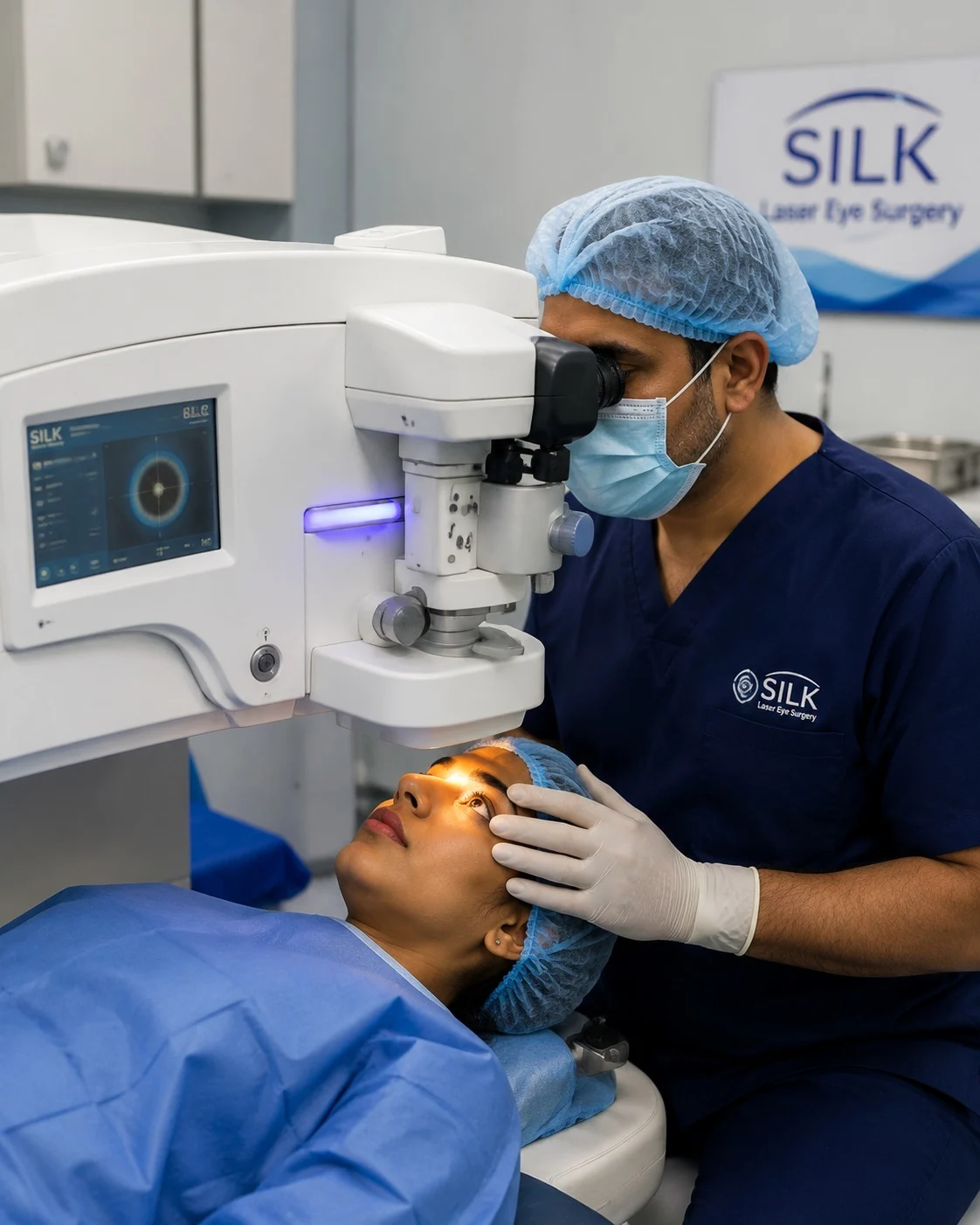
- In theatre, a suction ring gently holds the eye still and a curved contact glass docks onto the cornea. You feel pressure, and your vision goes dim or grey for perhaps twenty seconds. This is the part patients find strange rather than painful.
- The laser runs. Both eyes are usually done in one sitting, and total theatre time is around fifteen minutes.
- The surgeon separates the disc and lifts it out through the small opening. There are no stitches. Nothing is repositioned.
- You rest for a short while and go home the same morning. Take someone with you; you should not drive that day.
Most people are comfortable within a few hours, with some watering and grittiness that evening. Vision is usually functional the next day and continues to sharpen over the following week. Compared with LASIK, the first day is often very slightly hazier and the endpoint is much the same.
The limitations, stated plainly
SILK is not a universal upgrade, and there are things it does not do.
- It does not treat long-sightedness. Flapless lenticule procedures are used for short-sightedness and myopic astigmatism. If you are hyperopic, LASIK or PRK is your route, not this.
- It does not fix a cornea that is too thin or irregularly shaped. The disc still comes out of the cornea's total thickness. If the scans show a suspicious topography, no laser procedure is safe, flapless or otherwise.
- Fine-tuning afterwards is less straightforward. If a LASIK eye needs a small enhancement, the flap can be lifted. There is no flap here, so a touch-up is usually done as a surface treatment, with the slower recovery that involves. It is uncommon, but it is a real difference.
- It costs more. The platform and per-case consumables are expensive, and that reaches the patient. Whether the difference is worth it depends on your eyes, not on the label.
- It will not stop reading glasses. If you are in your forties, correcting distance vision fully means near vision needs help sooner than you expect. That is arithmetic, not a complication, and it should be planned before surgery rather than discovered after.
How we decide whether it suits you
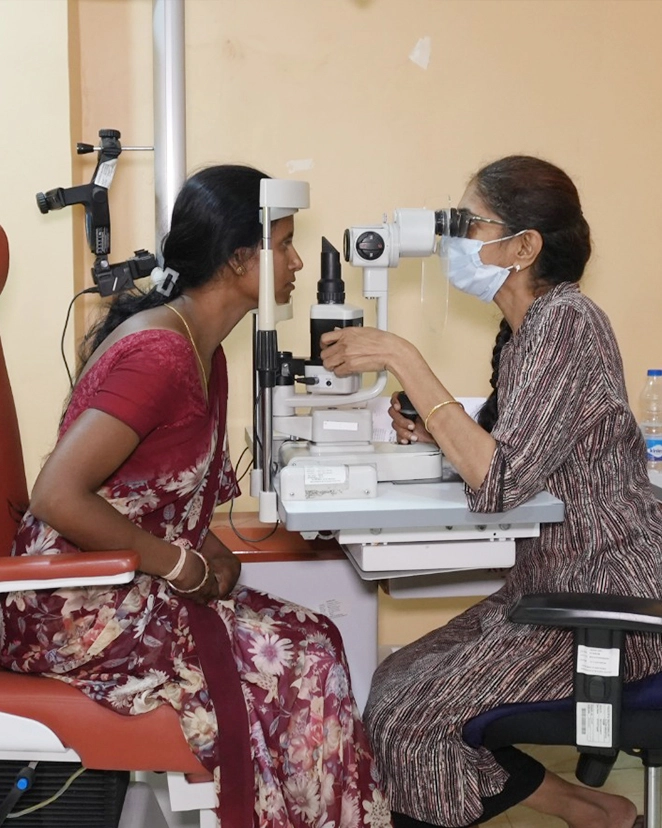
The workup measures corneal thickness at multiple points, maps the shape of both the front and back surfaces, checks pupil size in dim light, assesses tear film quality and confirms your prescription has been stable for at least a year. The retina is examined under dilation. Those results, not the patient's preference and not the newest machine in the building, decide the recommendation. A good number of people who come in asking for SILK by name are better served by LASIK, by PRK, or by continuing with glasses.
SILK is available at our Masab Tank flagship and at KPHB. If you would like your eyes assessed properly, book a refractive workup, read more about the SILK procedure, or see who would be examining you on our doctors page. Allow half a day, and bring someone to drive you home.