SILK is the newest of the laser vision correction procedures we offer, and it is a real advance for the right eye. It is also not the right procedure for everybody, and a fair share of people who come in asking for it by name leave with a recommendation for something else. Both halves of that sentence matter.
What the procedure actually involves
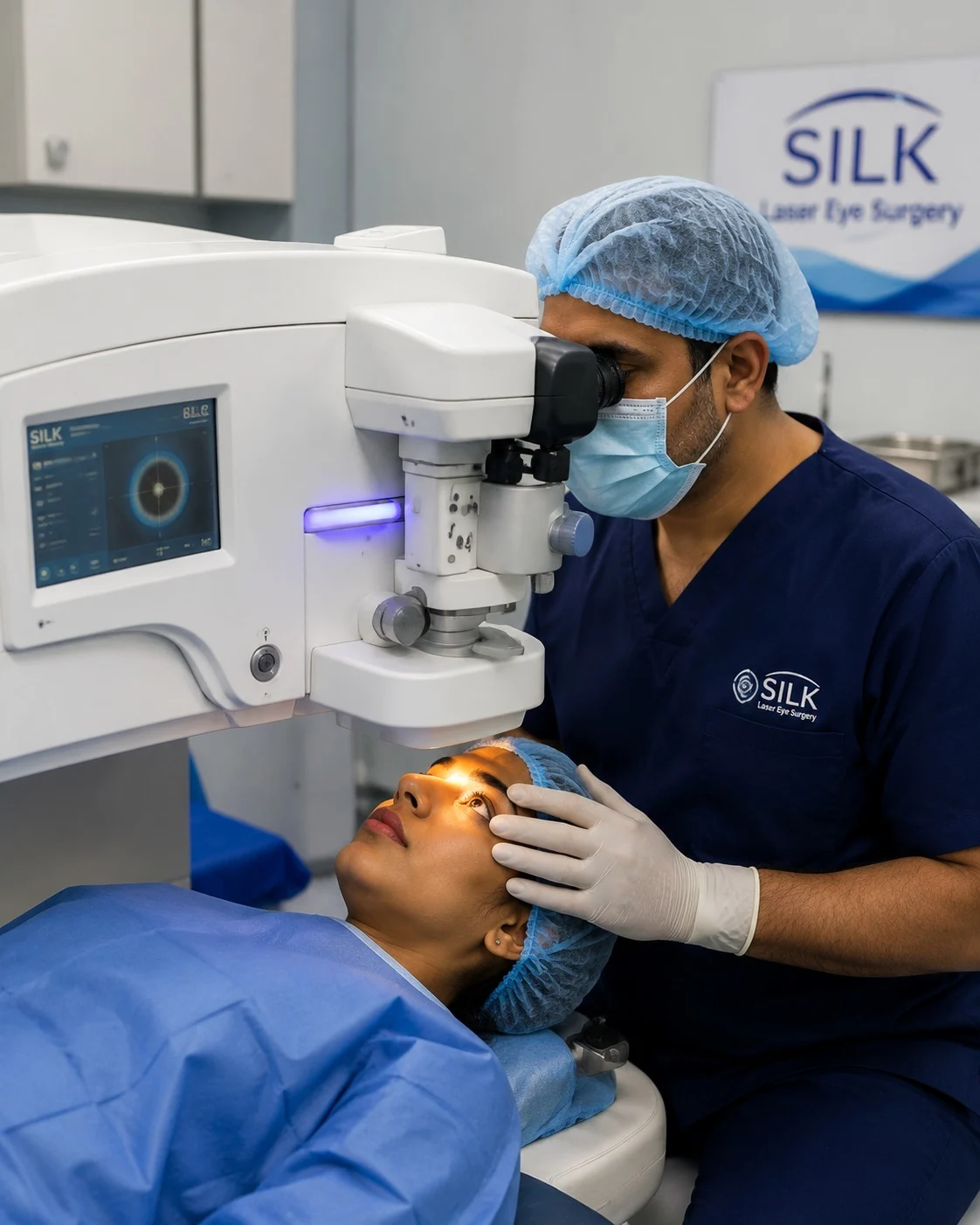
SILK stands for Smooth Incision Lenticule Keratomileusis, performed on the ELITA femtosecond laser. In practical terms, the laser works inside the cornea to shape a thin disc of tissue, called a lenticule, and the surgeon removes that disc through a small opening of two to three millimetres at the edge. Correcting your power is a matter of the shape of the disc that is taken out.
The important difference from LASIK is what is not done. LASIK cuts a hinged flap across most of the cornea, lifts it, applies the excimer laser underneath and lays the flap back down. SILK leaves the surface of the cornea almost entirely intact apart from that small opening. Nothing is lifted and nothing needs to reseat.
The laser step takes well under a minute per eye. You are in theatre for around fifteen minutes for both.
Who it suits well
Three groups benefit most clearly.
People in contact sport, uniformed services or dusty and physical work. A LASIK flap heals but never bonds to the same strength as untouched cornea. A hard blow to the eye years later can, rarely, displace it. If you box, play rugby or kabaddi, train in martial arts, or work on construction sites and factory floors, removing that consideration altogether is worth something.
People with borderline dry eye. Creating a large flap cuts across corneal nerves that regulate tear production, and that is why dry eye after LASIK is common in the first few months. SILK divides far fewer of those nerves, so the dryness phase tends to be shorter and milder. If your tear film is already marginal, this is the single strongest argument for choosing it.
Moderate to high myopia with or without astigmatism, in a cornea of normal thickness. This is the range the procedure was designed around and where it performs most predictably. The smooth lenticule surface the ELITA platform produces is part of why visual recovery is usually quick.
Who it does not suit
This is the part worth reading twice.
- Hyperopia, or long sight. Lenticule extraction is built around myopia and astigmatism. If you are long-sighted, LASIK is the established treatment and SILK is not an alternative for you.
- Low prescriptions, under roughly -1. The lenticule at that power is extremely thin and awkward to remove cleanly. Surface treatments handle these eyes better.
- Thin corneas or any suspicion of keratoconus. This rules out every laser procedure, not just SILK. The screening topography decides it, and if the map is irregular the answer is no, permanently. An implantable lens is usually the route instead.
- A prescription that is still changing. Same rule as LASIK. You want a year or two of stability before anyone touches the cornea.
- Anyone hoping to also fix reading vision. SILK corrects distance. Presbyopia arrives in the forties regardless, and reading glasses will follow.
- Significant untreated dry eye, active infection, uncontrolled diabetes or pregnancy. These are temporary or treatable barriers in most cases, but they are barriers.
Honest comparison with LASIK
LASIK has been done for over thirty years, on tens of millions of eyes, with follow-up data stretching across decades. SILK is newer. The early results are very good, but "very good over five years" is not the same body of evidence as "very good over twenty-five". That is not a reason to avoid it. It is a reason to be sceptical of anyone presenting it as strictly superior in every respect.
Where LASIK still holds an edge: it treats a wider range of prescriptions including hyperopia, it is more straightforward to enhance later if a small residual power remains, and vision on day one is often marginally sharper. Where SILK holds an edge: no flap, less dry eye, better structural integrity of the cornea, and a smaller incision.
Both are excellent operations. The choice comes out of your corneal scans, your prescription and how you use your eyes, and a surgeon who offers only one of them will inevitably recommend that one. Our refractive clinic assesses for all the options together, including PRK and ICL, because roughly one patient in five is best served by something other than what they walked in asking for.
Recovery, cost and where it is available
Recovery is straightforward. Most patients see functionally the next morning and are cleared to drive within a few days. Drops run for several weeks on a tapering schedule. No rubbing the eyes for a month, no swimming for two weeks. Because there is no flap to protect, the day-to-day restrictions are slightly lighter than after LASIK, but the drops schedule is not optional.
On cost, flapless lenticule procedures in Hyderabad generally sit at the upper end of the laser vision correction range, above standard and bladeless LASIK. What moves the figure is the platform and the complexity of your correction, not the length of your consultation. Ask for the total in writing and confirm whether the pre-operative evaluation, medication and all follow-up visits are included. Like all refractive surgery, it is elective, so insurance will not cover it.
We run SILK on the ELITA platform at two centres only: the flagship at Masab Tank and KPHB. Our Warangal, Nalgonda and Badvel centres do full refractive assessments and general eye care, but the SILK laser itself is at those two sites.
The sensible next step is the evaluation rather than the booking. It takes two to three hours, your eyes will be dilated so bring someone to drive you home, and stop contact lenses a week beforehand. At the end of it you will know which procedure fits your eyes, or whether the answer is none of them for now.