Adult eye care is mostly about restoring what was lost. Children's eye care is about making sure the vision develops in the first place. That difference is the whole reason paediatric ophthalmology exists as a separate speciality, and it is why timing matters more here than anywhere else in the eye.
The wiring window
A newborn cannot see much. Over the first months, clear images travelling from each eye to the brain build the visual pathway, roughly the way a language is learned by hearing it. The sensitive period is most intense in the first two or three years and tapers off through the primary school years.
If one eye sends a blurred, blocked or misaligned image during that period, the brain wires around it. That eye ends up with reduced vision that spectacles cannot correct, because the limitation sits in the pathway, not in the eye. Treat it while the pathway is still plastic and it usually recovers. Treat it late and the recovery is partial. Treat it after the window closes and you are largely holding what is there.
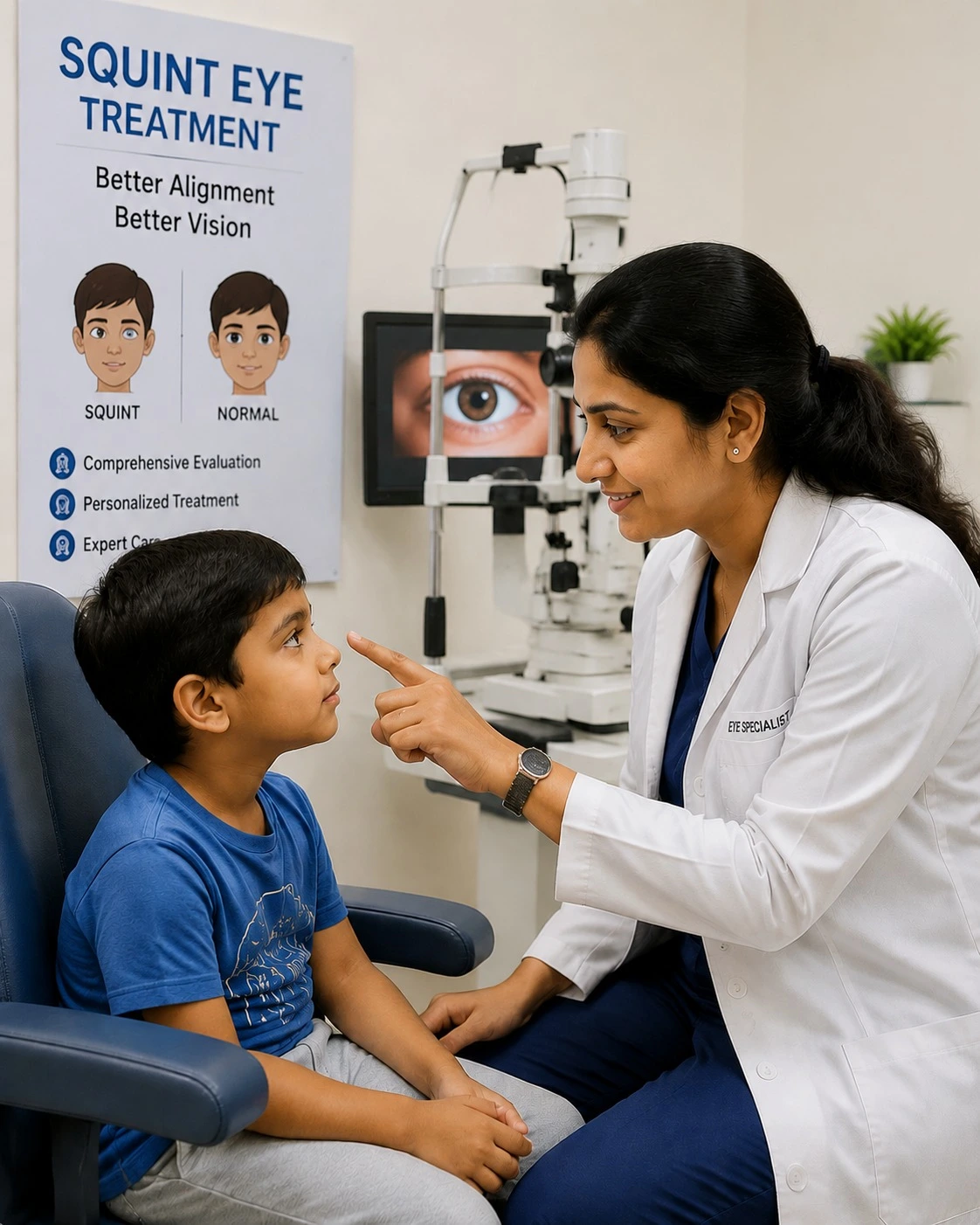
This is why we take an eight-month-old's squint more seriously than an adult's, and why "he will grow out of it" is advice we push back on.
Conditions with a deadline
Congenital cataract
A clouded lens present at birth blocks the image completely. In a dense one-sided cataract, surgery is generally needed within the first weeks to few months of life, and it must be followed by careful optical correction and amblyopia therapy for years. Removing the cataract is the easy part. Getting the brain to use the eye afterwards is the long work. The sign to watch for is a white or dull pupil, often first noticed in a flash photograph.
Retinopathy of prematurity
Babies born early, or with low birth weight, can develop abnormal blood vessel growth in the developing retina. It causes no visible symptom, cannot be seen by looking at the child, and can progress to retinal detachment. The only protection is a screening examination on a fixed schedule, starting within the first weeks after birth, arranged by the neonatal unit. If your baby was in an NICU, confirm this screening was done before discharge. If nobody mentioned it, ask. Our retina service works with paediatricians on these cases.
Amblyopia
The commonest of the group. It follows a squint, a big difference in spectacle power between the two eyes, or anything that blocks a clear image such as a droopy lid. A child with amblyopia in one eye behaves entirely normally, which is exactly why it is missed. The three-year vision check exists mainly to catch it. Treatment is glasses plus patching or atropine drops for the stronger eye, over months.
Congenital glaucoma
Uncommon but urgent. High pressure inside a young eye stretches the still-soft eyeball, so the classic signs are an eye that looks unusually large, a hazy or cloudy cornea, watering and marked discomfort in bright light. Parents often describe a baby who buries their face away from light. It needs surgical pressure control quickly to protect the optic nerve, and lifelong follow-up afterwards through a glaucoma service.
Blocked tear duct, the one that usually resolves
We include this deliberately, because not every childhood eye problem is a race. A baby with a constantly watering, sticky eye very often has a narrow tear drainage passage. The large majority open on their own during the first year with nothing more than correct massage over the tear sac and hygiene. Probing is considered later, if it persists. If someone recommends an immediate procedure on a healthy three-month-old with simple watering, get a second opinion. Our oculoplasty team sees these regularly and most are managed without surgery.
What early care costs, and what late care costs
An early assessment is a consultation, a dilated refraction and, if needed, a pair of spectacles and a patching plan. It is inexpensive, involves no anaesthesia and no hospital stay, and the main burden falls on parents in the form of persistence.
Late presentation looks different. A child brought in at eleven with a squint and a weak eye may still benefit from surgery for alignment, but the vision in that eye is often fixed at a level below normal for life. It affects depth perception, and later on it narrows some career options where binocular vision or a minimum standard in each eye is required, including certain defence, aviation and driving categories. The cost is not really financial. It is that a treatable thing became permanent.
There is a fair question in the other direction: does every child need a hospital visit? No. A child with no symptoms, no family history and a normal school screening does not need repeated specialist visits. The value sits in a small number of well-timed checks, particularly around age three and before school entry, and in acting quickly when a sign appears.
How we run paediatric care across our centres
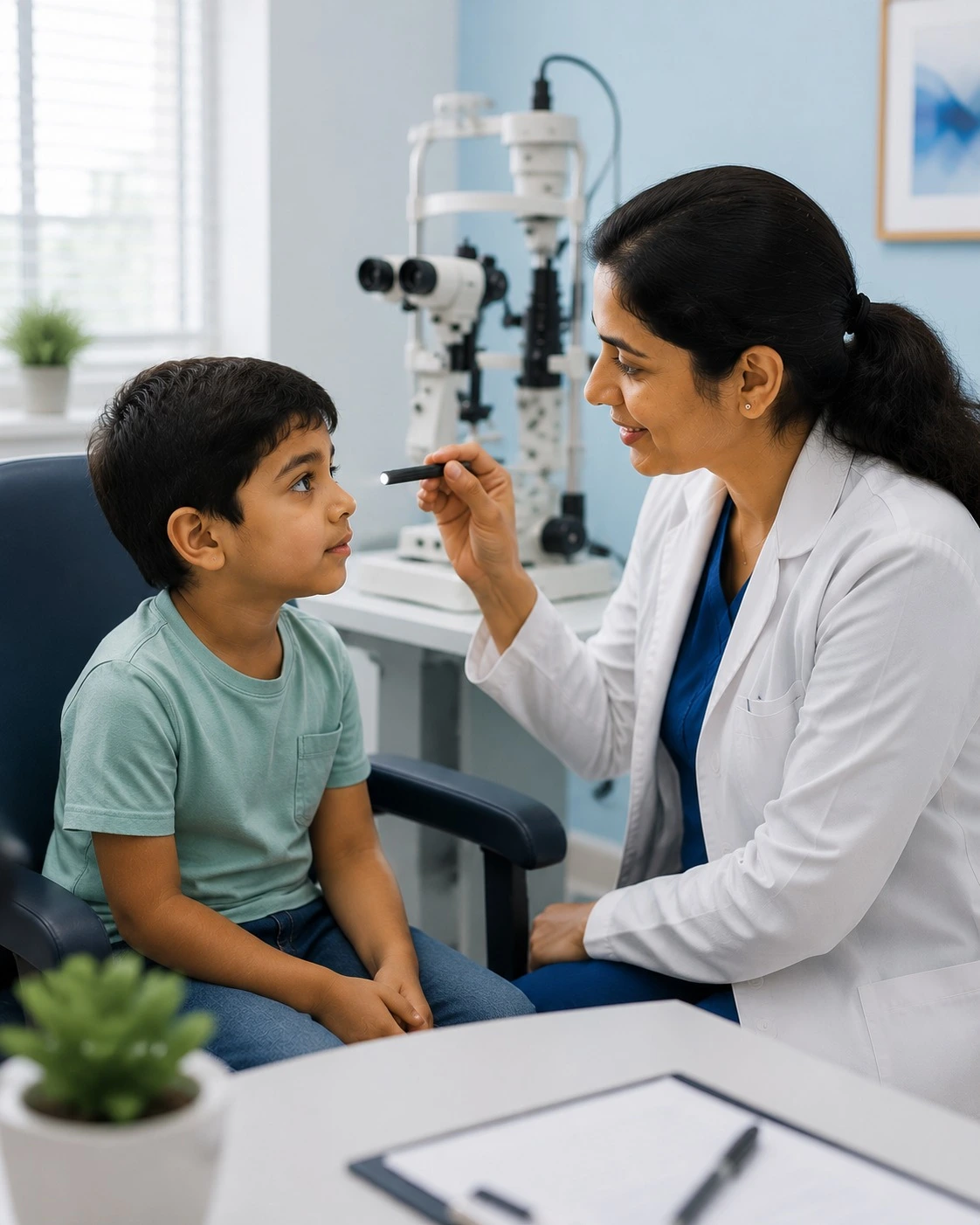
Testing a three-year-old is not a scaled-down adult examination. It uses picture charts, matching cards and preferential looking tests for infants, along with cycloplegic refraction and a dilated retina check. It also needs staff who can hold a child's attention for the twenty minutes that matter, which is a practical skill more than a technical one.
Children are seen at all five of our centres. Complex paediatric work, squint surgery and any procedure needing general anaesthesia is handled at the flagship Masab Tank hospital, which has inpatient beds and round-the-clock cover. Routine paediatric consultations, refraction and amblyopia follow-up run at KPHB, Warangal, Nalgonda and Badvel, which usually suits families better since patching reviews come round every few weeks.
If your child has never had a formal eye examination, the useful next step is simply to book one and get a baseline on record. Details of our paediatric service are on the children's eye care page, and you can call +91 90001 80035 to find the nearest centre with a paediatric clinic running that day.