From March to June our outpatient departments across Hyderabad, Warangal and Nalgonda see a predictable shift: more allergic conjunctivitis, more gritty dry eyes, more contact lens problems and more people arriving with a red eye they have been treating with the wrong drops for a week. Almost all of it comes down to three exposures — ultraviolet light, airborne dust and dry moving air — and each one needs something different from you.
Ultraviolet is the part people underestimate
UV damage to the eye is cumulative and painless. It does not announce itself the way sunburnt skin does. Over decades it contributes to cataract, to pterygium — that fleshy triangle of tissue that creeps across the white of the eye from the inner corner — and to changes at the macula. Outdoor workers, drivers, farmers and anyone who spends hours on a two-wheeler carry the highest lifetime dose.
What actually protects you:
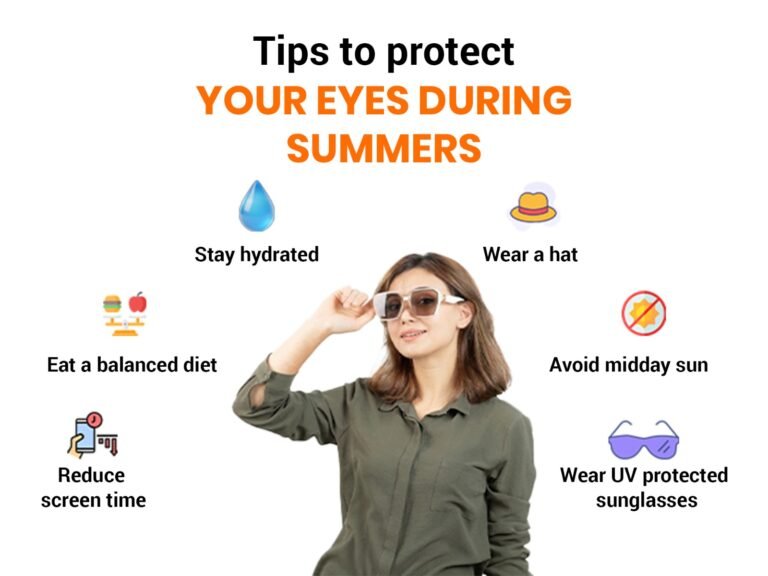
- Sunglasses with a genuine UV400 rating. The specification matters far more than the darkness of the tint.
- Wraparound or larger frames. A significant amount of UV reaches the eye from the sides and from reflected ground light, which narrow lenses do nothing about.
- A cap or hat. A brim cuts a large share of overhead UV on its own and works alongside sunglasses rather than replacing them.
- Clear spectacles with UV coating. If you wear glasses anyway, this is worth asking for. It is inexpensive.
Here is the part worth knowing: a dark tinted lens with no UV filter is worse than no sunglasses at all. The darkness makes the pupil open wider, and a wider pupil lets in more of the ultraviolet the lens is not blocking. Roadside sunglasses sold with no UV specification are exactly this. If you cannot confirm UV400, you are better off squinting.
Dust, wind and the urge to rub
Summer air in this region carries fine dust, pollen and construction particulate. In sensitive people this triggers allergic conjunctivitis: itching first, then redness, watering, and a stringy discharge. Itching is the giveaway — bacterial infection burns and sticks the lids shut, allergy itches.
The single most damaging response is rubbing. It releases more histamine, so the itch returns worse ten minutes later, and in children with persistent allergic eye disease, years of hard rubbing is one of the recognised risk factors for keratoconus — a progressive thinning and bulging of the cornea that we then have to treat with corneal cross-linking. If your child rubs their eyes constantly through summer, treat the allergy properly rather than repeating "don't rub".
What helps instead:
- A cold compress — a clean cloth wrung out in refrigerated water — for five minutes. It genuinely reduces itching.
- Preservative-free lubricating drops kept in the fridge, used to flush allergen out.
- Rinsing the face and eyelids with plain water after coming in from outside.
- A proper antihistamine or mast-cell stabiliser eye drop prescribed for the season, if symptoms recur every year.
Air conditioning dries eyes more than the sun does
Most summer dry eye we see is not from being outdoors. It is from sitting under a vent for nine hours. Moving dry air strips the tear film faster than it can be replaced, and if you are also looking at a screen — where the blink rate drops by roughly half — the two effects compound.
Redirect the vent away from your face. Keep a glass of water at the desk and actually drink it; mild dehydration in 42-degree weather shows up in the eyes early. Use preservative-free lubricating drops rather than the "redness relief" bottles, which contain a vasoconstrictor that whitens the eye for an hour and leaves it redder afterwards. If your eyes still burn by evening, the problem is usually not simple dryness — read our note on why artificial tears alone often are not enough.
Contact lens wearers should shorten wearing time in summer, never top up a lens case with old solution, and never swim in lenses. Water — pool, lake or tank — carries Acanthamoeba, an organism that causes a corneal infection so painful and so hard to treat that it is one of the few things that genuinely frightens corneal surgeons.
Red eye in summer: what to do, and what not to
Most summer red eye is allergic or a self-limiting viral conjunctivitis that runs for a week to ten days and spreads easily through a household by shared towels and hands. Cold compresses, lubricants, separate towels and frequent handwashing cover it.
What not to do is put steroid drops in it. Steroid eye drops are freely available at pharmacies here and are commonly handed out for "eye redness". Used on an undiagnosed red eye they can turn a herpes infection into a corneal ulcer, and used for weeks they raise eye pressure and can cause steroid-induced glaucoma — which is permanent. We see the consequences of this every summer.
Come in the same day, or go to an emergency eye service, if there is real pain rather than irritation, blurred vision, a white spot on the cornea, marked light sensitivity, or if a red eye has not started improving after four or five days.
None of this needs an appointment for most people — the sunglasses, the cold compress and the redirected AC vent do the bulk of the work. But if you are getting the same red, itchy eyes every summer, a single visit to sort out the right seasonal drop saves you three months of discomfort each year. Our KPHB centre sees walk-ins till 8:30 pm, and you can find all five locations on our branches page.