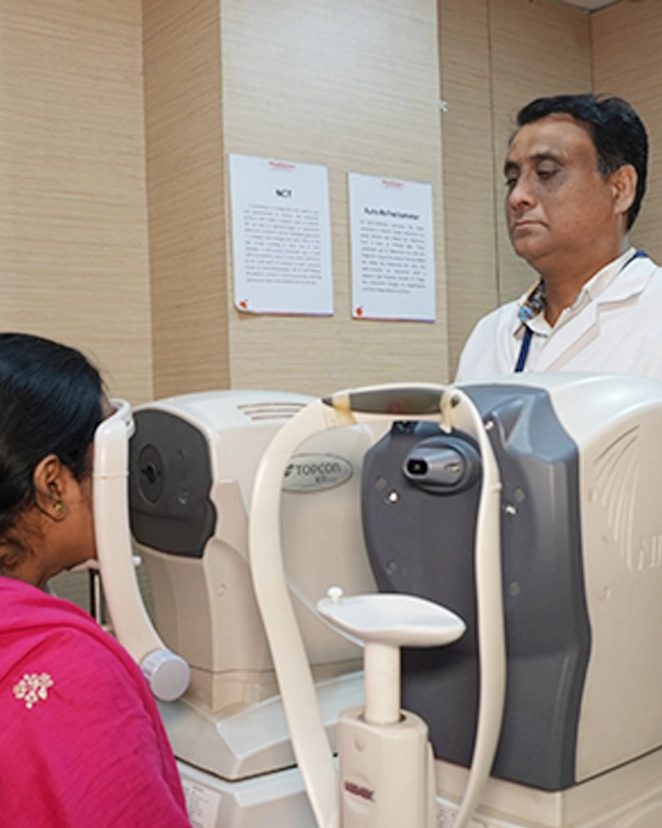
The eye is the only part of the body where a doctor can look directly at blood vessels and a nerve without cutting anything open. That is the practical reason an eye examination is worth doing even when you can see perfectly well. It is a fifteen-minute window into circulation, blood sugar control and pressure inside the eye — three things that damage sight silently for years before you notice anything.
What a proper check picks up before you feel it
Four conditions account for most of the preventable vision loss we see, and all four are quiet in their early stages.
- Glaucoma. Pressure damages the optic nerve from the outer field of vision inward. Your brain fills in the missing patches, so people routinely lose 30 to 40 per cent of their nerve fibres before noticing. Lost field does not come back. Pressure-lowering drops or laser started early can preserve what is left for decades. This single fact is the strongest argument for a yearly test after 40.
- Diabetic retinopathy. Central vision stays sharp while the peripheral retina quietly leaks and bleeds. By the time reading becomes difficult, the disease is usually advanced. Anyone with diabetes needs a dilated retinal examination every year from the date of diagnosis, regardless of sugar control or how good their vision feels.
- Hypertensive changes. Narrowed arterioles and small haemorrhages in the retina are often the first physical evidence that blood pressure has been uncontrolled for a while.
- Macular degeneration. Early drusen are visible on examination long before distortion appears. Detecting the wet form within weeks of onset changes the outcome substantially.
Cataract is on this list too, but it is an exception: it announces itself with glare and dimming, and there is no penalty for finding it a year late.
Who actually needs a yearly test — and who does not
Annual screening is not equally useful for everyone, and we would rather say so than pretend otherwise.
- Every year: anyone over 40; anyone with diabetes at any age; anyone with a parent, sibling or child who has glaucoma; anyone on long-term steroids in any form; high myopes above about minus 6, who carry a higher lifetime risk of retinal detachment and glaucoma.
- Every two years: healthy adults between 20 and 40 with no symptoms, no family history and stable spectacle power.
- Children: once before starting school, then roughly every two years — sooner if there is squint, a family history of high power, or the teacher reports difficulty seeing the board.
- Immediately, not at the next annual visit: sudden floaters or flashes, a curtain across part of the vision, sudden painful red eye with blurring, or any abrupt loss of vision. These belong in an emergency room, not a diary entry.
What the examination should include
A vision check at an optical counter is not an eye examination. When you book, the visit should cover at minimum:
- Vision measured in each eye separately, with and without your current glasses.
- Refraction, to establish whether your prescription is still right.
- Intraocular pressure measurement.
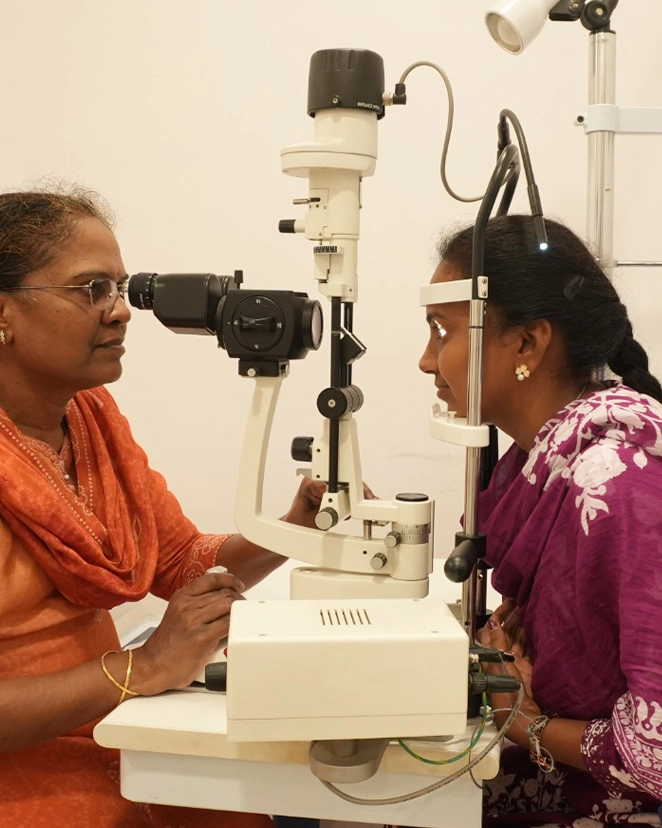
- Slit-lamp examination of the front of the eye — cornea, lens, tear film.
- Examination of the retina and optic nerve, dilated if you are over 40, diabetic, highly myopic or being screened for glaucoma.
Further tests — OCT scanning of the macula and nerve, ultra-widefield retinal imaging, or a Humphrey visual field test — are added when something on that basic examination warrants them. They should follow a finding, not precede one. If a clinic runs every test on every walk-in patient, ask what specifically prompted each one.
What it costs and how long it takes
A standard consultation with refraction and pressure check at a private hospital in Hyderabad typically runs in the few-hundred-rupee range and takes around 30 to 45 minutes. Dilation adds waiting time — roughly 30 minutes for the drops to work and four to six hours of blurred near vision afterwards — but very little cost. Imaging such as OCT or a visual field test is charged separately, usually in the low thousands per test, and the price varies with how many scans are needed.
Two practical points. Do not drive yourself home after dilation; arrange a lift or a cab. And bring your current spectacles, any previous prescription, your latest HbA1c or sugar reports if you are diabetic, and a list of medications, including steroid inhalers, skin creams and joint injections. Steroids raise eye pressure in a significant minority of people, and patients almost never mention them unless asked.
Making it happen
The reason most people skip this is scheduling, not scepticism. If that is the obstacle, pick the branch that fits your week rather than the one nearest to you. Our KPHB centre runs until 8:30 pm on weekdays; Warangal and Nalgonda are open seven days a week, which usually solves the problem for working families.
If you have not had your eyes examined in the last two years and you are over 40 or diabetic, book one this month. If you had a full check last year and nothing has changed, you can safely wait. You can see the full scope of a comprehensive eye examination or call +91 90001 80035 to ask what your situation actually needs.