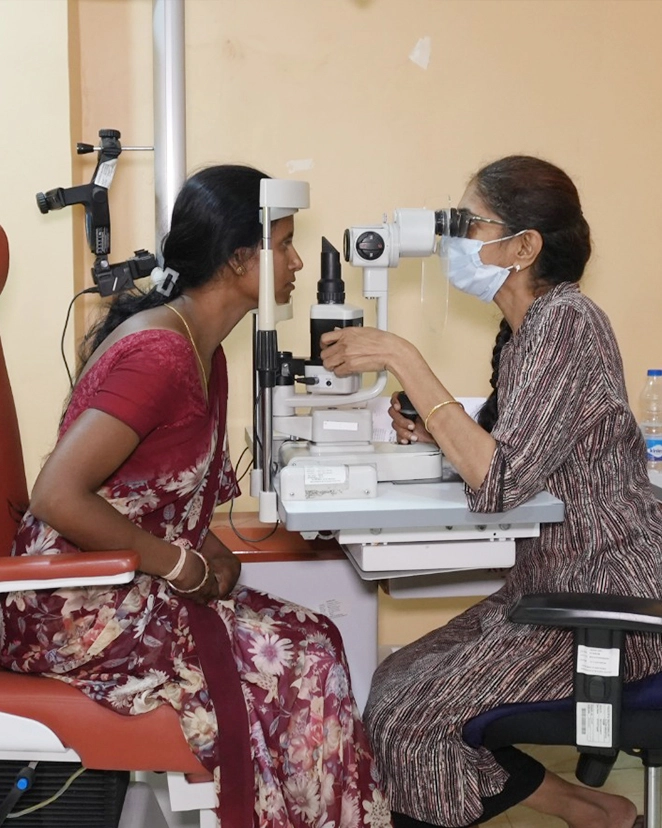

Most people walk into a LASIK consultation without a single question prepared, and walk out with a date booked. That works out fine most of the time, because most eyes are straightforward and most surgeons are careful. But it puts you entirely in the hands of whoever is across the desk. Five questions change that, and none of them require you to know anything about ophthalmology. What matters is not just the answer you get but whether the answer refers to your eyes or to the hospital's equipment.
1. What did my corneal scans show, and how much cornea will be left afterwards?
This is the safety question, and it is the one to ask first. Every laser procedure removes tissue. Your cornea has a starting thickness, usually somewhere between 500 and 580 microns, and after the treatment a residual bed has to remain. Go below the safe minimum and you risk ectasia — a slow, progressive bulging and weakening of the cornea that is much harder to live with than glasses ever were.
A good answer sounds like numbers. Your thickness is this, your correction needs roughly this many microns, you will be left with that, and the safe floor is around 250 to 300 microns depending on how conservative the surgeon is. A good answer also mentions the shape of your cornea, not only its thickness, because an irregular topography rules out laser correction even in a thick cornea.
A weak answer is "you are suitable, don't worry about it". You are entitled to see your own topography map and have it explained. It takes two minutes.
2. Why this procedure for me, rather than the other options?
LASIK, PRK and the flapless procedures all correct the same range of prescriptions. The right choice depends on your corneal thickness, your tear film, your pupil size in the dark, your prescription and what you do with your days. Two people with identical spectacle powers can genuinely need different operations.
So the answer should be specific to you. "Your cornea is on the thinner side, so we are avoiding a flap" is a real answer. "Your tear film is marginal, so we would rather not cut that many nerves" is a real answer. "This is the latest technology" is not an answer to the question you asked — it describes a machine, not your eye.
Be equally alert to the reverse. If you are being steered towards the most expensive option and nobody can explain what it does for your particular measurements, ask what the cheaper option would give you and where it would fall short. Sometimes the honest reply is "very little difference", and you should hear it.
3. Who is actually performing the surgery, and how often?
In a busy hospital the person who counsels you is not always the person who operates. That is not sinister, but you should know the name of the surgeon and be able to meet them before the day. Ask how many refractive procedures they do in a typical month and how long they have been doing this specific one. Femtosecond and lenticule techniques have a real learning curve.
Ask, too, what happens if something goes off script during the procedure — a suction break, an incomplete separation, a flap complication. These events are uncommon, but the correct response is practised, not improvised. A surgeon who has managed them will describe the plan without hesitating. You can see the team who would be looking after you on our doctors page.
4. What is my realistic result, and what happens if I end up undercorrected?
Laser correction is very good, not perfect. The great majority of suitable patients reach driving-standard distance vision without glasses. A minority end up slightly under- or over-corrected — perhaps needing a thin prescription for night driving — and a small number choose an enhancement later.
The question is what your surgeon expects specifically for your power, and what the plan is if you land short. Is an enhancement included in the fee or charged again? How long must you wait before one can be done, and does your chosen procedure make a touch-up simple or awkward? A LASIK flap can be lifted. After a flapless procedure the retreatment is usually a surface treatment, with a slower recovery.
Anyone promising you a guaranteed six-by-six is overselling. Anyone giving you a percentage and a fallback plan is being straight with you.
5. What do the first six months honestly look like?
Recovery is usually easy, but it is not nothing, and the things that surprise patients are almost always the things nobody warned them about.
- Dry eyes for three to six months are common after LASIK and milder after flapless procedures. You will use lubricant drops for a while. If your eyes are already dry, this needs treating before surgery, not after.
- Night-time glare and haloes around headlights and streetlights are normal in the early weeks and settle for most people. Large pupils in dim light make this more likely, which is why pupil size is measured.
- Fluctuating vision through the first few weeks, sharper in the morning and softer by evening, is expected.
- Restrictions: no rubbing the eyes, no swimming for a few weeks, no dusty sites or gym for a short period, and sunglasses outdoors. Ask for the list in writing.
- Follow-ups: day one, week one, then at intervals through the first year. Ask which of these are included.
And one thing that is not recovery at all: if you are in your forties, correcting your distance vision fully means reading glasses arrive sooner than they otherwise would have. That is worth discussing before you book, not afterwards.
If the answers you get are specific, unhurried and occasionally discouraging, you are in the right place. Being told you are not a candidate is a good outcome, not a wasted trip — it means somebody read your scans properly. Our refractive workup takes two to three hours with dilation, and you are welcome to bring this list with you to Masab Tank, KPHB or any of our other centres.