Almost every eye hospital in Hyderabad advertises "advanced" care. The word has been used so often that it now tells a patient nothing. So it is worth setting out what it should mean, and what it does not.
Advanced does not mean the newest machine in the room. It means the diagnosis is right, the decision is honest, and the follow-up actually happens. Equipment supports all three. It replaces none of them.
Measurement comes before everything else
Most poor surgical results are not surgical failures. They are measurement failures. If the length of the eye is measured wrong by a fraction of a millimetre before cataract surgery, the lens power will be wrong, and no amount of skill during the operation fixes that afterwards.
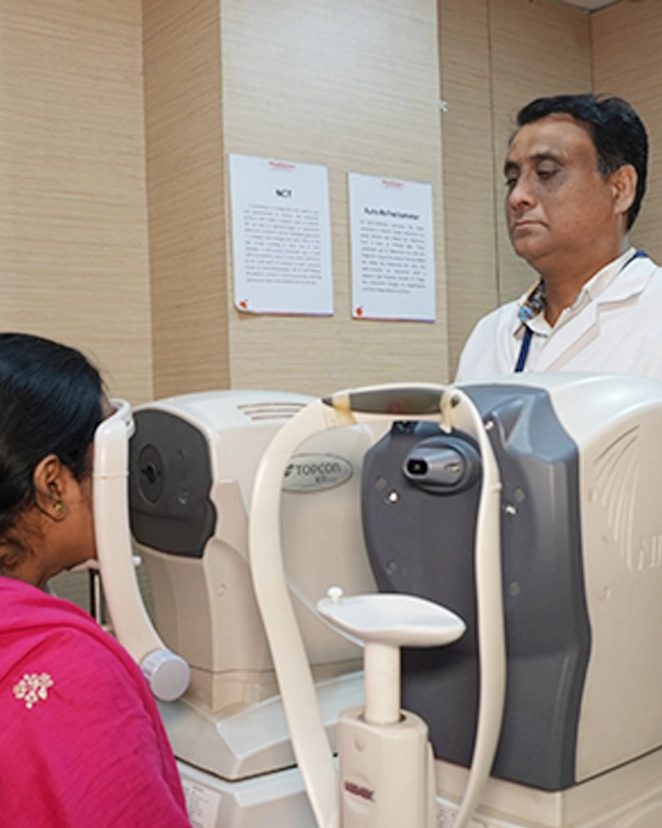
This is where good equipment genuinely earns its place. Optical biometers like the IOLMaster 700 and the ARGOS take non-contact measurements of the eye in seconds, and the ARGOS handles dense cataracts that older machines struggle to read through. OCT scanning shows the retina in cross-section, layer by layer, so a swollen macula is visible before the patient notices any distortion. A Humphrey field analyser maps the exact shape of vision loss in glaucoma, which is how we tell a stable patient from one who is slowly losing ground.
What all of these have in common is that they produce a number or an image that can be compared against the same test done a year later. That comparison is the point. A single scan is a snapshot. A series of scans is information.
The second test is the honest decision
A hospital with good technology and poor judgement is a dangerous combination, because the technology makes the poor judgement look authoritative.
The question a patient should be able to ask is simple: is this being recommended because I need it, or because it is available? A few examples of where the honest answer is often no:
- A cataract that is visible on examination but is not affecting how you read, drive or work. It can wait. Cataract surgery is not more difficult six months later in most cases, and the decision belongs to you.
- A premium multifocal lens offered to someone who drives at night for a living. The trade-off in glare and halos is real for that person even if most patients tolerate it well.
- LASIK for someone whose spectacle power is still changing, or whose cornea is too thin. The correct answer is to wait or to decline, and to say so plainly.
- An expensive imaging scan repeated at every visit when nothing has changed clinically and the last scan was normal.
Being told that you do not need something is a service. It is also the fastest way to judge whether the advice you are getting is sound.
Sub-speciality depth, not one doctor for everything
The eye is small, but the conditions that affect it are not related to each other. A retinal detachment, a squint in a four-year-old, a corneal ulcer and advanced glaucoma need four different sets of hands. General ophthalmology handles a large share of what walks in, and handles it well. Beyond that, depth matters more than breadth.
Across our five centres we have more than 30 specialists working in defined areas, and the practical benefit is not the number. It is that a patient who arrives with blurred vision and turns out to have a retinal problem is seen by someone who does retina every day, usually the same week, without being sent across the city to start again from scratch. At the KPHB centre, that includes cataract, refractive surgery including SILK and LASIK, retina, glaucoma and paediatric care, with the flagship at Masab Tank as the referral point for anything that needs admission or round-the-clock cover.
Follow-up is the part nobody advertises
The unglamorous truth is that most of the vision saved in an eye hospital is saved in the review clinic, not the operating theatre.
Diabetic retinopathy is the clearest example. A person with diabetes may have significant retinal damage and perfectly good vision at the same time, because the centre of the retina is still spared. The damage is silent until it is not. The only thing that reliably prevents that outcome is a dilated retinal examination on schedule, every year, whether or not anything feels wrong. The same logic applies to glaucoma, where the field of vision narrows from the edges so slowly that the brain fills in the gap.
So when you are judging an eye hospital, ask what happens after the procedure. Who reviews you at one day, one week, one month. Whether your scans from last year can actually be pulled up and compared. Whether the same doctor sees you or you start over each time. Those are dull questions with more bearing on your vision in ten years than the brand of laser used for twenty minutes.
What this looks like in practice
MediVision has been running since 1993, and after 34 years and more than 1,35,000 surgeries, the pattern is fairly clear to us. The cases that go well are the ones where somebody measured carefully, explained the trade-offs without overselling, and then kept an eye on the patient afterwards. The cases that go badly are usually the ones where a step was skipped early and nobody went back to check.
Technology helps at every one of those steps. A femtosecond laser makes certain parts of cataract surgery more predictable. Ultra-widefield imaging catches peripheral retinal problems that a standard camera misses. But the machine does not decide whether you need surgery, does not tell you the honest downside, and does not remember to call you back in six weeks.
If you are choosing where to go, the useful test is not the equipment list on the website. It is whether, at the end of your consultation, you understand what is wrong, what your options are, what each one costs, and what happens if you do nothing at all. If you leave without those four answers, ask again.
You can book a consultation at any of our five centres, or call +91 90001 80035 if you are not sure which one is right for what you need. If you already have old scans or a previous prescription, bring them. Comparison is worth more than a fresh test.