Glaucoma removes vision from the outside edges inwards, and it does it slowly enough that the brain quietly fills in the missing parts. By the time a patient notices something is wrong, a large share of the optic nerve fibres in that eye is usually already dead, and nothing we have brings them back. That single fact explains why we push so hard on screening for a disease that, for years, produces no symptom whatsoever.
What is actually happening inside the eye
The eye continuously makes a clear fluid that nourishes the lens and cornea, and drains it away through a fine mesh sitting in the angle where the iris meets the cornea. Production and drainage are meant to balance. When drainage falls behind, pressure inside the eye rises, and that pressure damages the optic nerve at the back, where a million or so nerve fibres leave the eye for the brain.
Fibres die from the outer parts of the visual field first. The centre, the part you read and recognise faces with, is the last to go. This is why a person can have advanced glaucoma in one eye and still read the bottom line of the chart.
One honest complication: pressure is not the whole story. A significant number of patients have normal-tension glaucoma, where the pressure reading sits in the normal range but the nerve is being damaged anyway, probably because of poor blood supply to the nerve head. A normal pressure reading on its own does not clear you. Equally, some people run pressures above average for decades with a perfectly healthy nerve. The nerve is what we are watching. The pressure is only the lever we can pull.
Why nothing feels wrong
Three things conspire to hide it. The field loss starts in the periphery, where you are not paying attention. Your two eyes overlap, so a gap in one is covered by the other. And the brain does not show you a black patch, it simply smooths over the missing area with whatever is nearby, the same way it hides your blind spot.
The practical consequence: a vision test that only checks how many lines you can read on a chart will miss glaucoma entirely, and will keep missing it until the damage reaches the centre. If your eye check consists of reading letters and getting a spectacle number, you have not been screened for glaucoma.
There is one loud exception. Acute angle-closure glaucoma, where the drainage angle shuts suddenly, causes severe eye and head pain, a red eye, blurred vision, coloured haloes around lights, and often vomiting. People sometimes go to a physician for the headache and nausea and lose hours. Pressure in an attack can be three or four times normal, and the nerve can be permanently damaged within a day. If that combination happens to you, treat it as an emergency and go to an eye casualty the same night. Our emergency service at Masab Tank runs round the clock on 040-4245 6666.
Who should be screened, and how often
- Everyone from age 40, as part of a routine eye examination, every two years.
- Everyone from age 60, every year.
- Anyone with a parent, brother or sister who has glaucoma. Start at 35 and repeat annually. This is the single strongest risk factor we know of, and families often do not discuss it. If a relative had eye drops for life or lost vision late in life, find out what they had.
- Anyone who has used steroids for a long stretch in any form, including eye drops bought over the counter for redness, inhalers for asthma, and skin creams. Steroid-induced pressure rise is common and completely silent.
- People with diabetes, who are already being examined for the retina and should have pressure and disc checked at the same visit.
- High myopes, roughly beyond minus 6, whose optic discs are harder to assess and more vulnerable.
- Anyone with a past eye injury or eye surgery, sometimes many years earlier.
What a proper glaucoma assessment involves
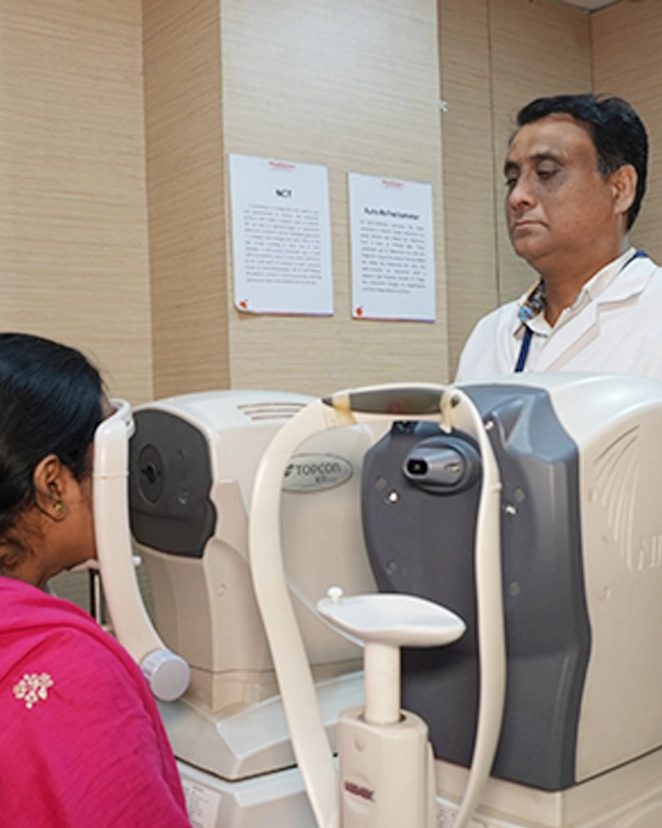
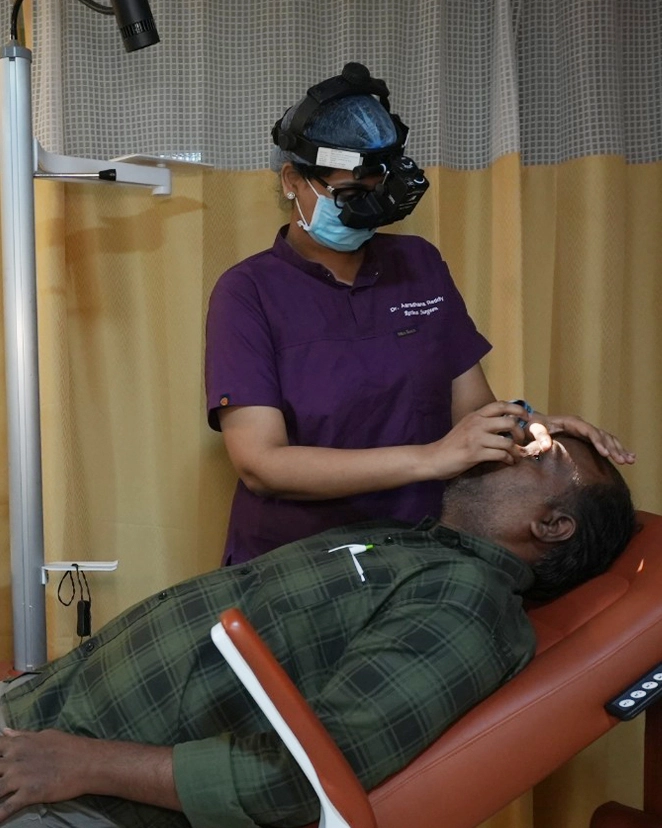
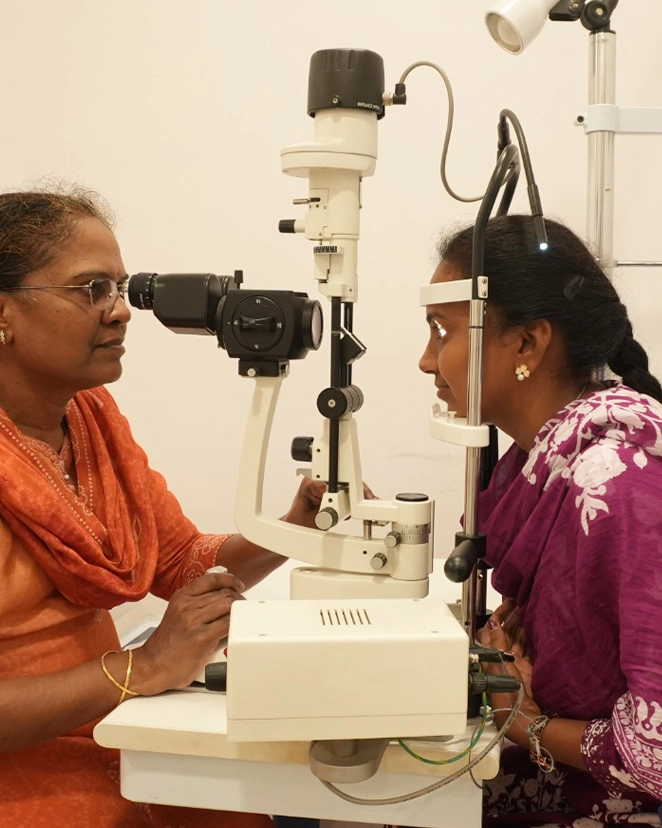
A five-second puff of air is a screening step, not an assessment. A real evaluation includes pressure measured properly by applanation, a note of your corneal thickness because a thin cornea makes the reading look falsely low, gonioscopy to see whether your drainage angle is open or narrow, a dilated look at the optic disc, an OCT scan measuring the thickness of the nerve fibre layer, and a Humphrey visual field test.
Two things worth knowing before you sit for it. The visual field test is tiring and most people feel they did badly, which is normal and expected. And a single visit rarely settles anything. Glaucoma is diagnosed and monitored on a trend, so the second and third set of scans a year later are what actually tell us whether anything is moving. Do not skip them because the first one was reassuring.
Treatment: what it can and cannot do
It cannot restore field you have already lost. Anyone who suggests otherwise is selling something. What treatment does is lower the pressure enough to stop or slow further loss, so that the vision you have today is still there in twenty years. Handled early, most people with glaucoma keep useful sight for life.
- Drops. The usual starting point, often a single drop at night. They work well when they are actually used.
- Laser trabeculoplasty. A few minutes in the clinic, no cutting, and increasingly offered before drops. It does not work for everyone, and the effect can fade after some years, but it can be repeated and it removes the daily-drop problem.
- Surgery, such as trabeculectomy or a drainage tube, when drops and laser are not holding the pressure down or the damage is advancing. It is effective and it needs close follow-up afterwards.
Be frank with us about side effects. Prostaglandin drops can redden the eye, darken the lid skin and lengthen lashes. Beta blocker drops can matter if you have asthma or a slow heart rate. There is almost always an alternative, and swapping is easy. What is not easy to fix is the commonest reason glaucoma progresses: people stop the drops after a few months because their vision feels perfectly fine. It feels fine precisely because the drops are working.
If you are over 40, or have a family history at any age, the sensible next step is one comprehensive examination that includes pressure, angle, disc and field. It takes about ninety minutes with dilation, and if everything is clear you will simply know when to come back. You can read more on our glaucoma page, see what a full check covers under comprehensive eye care, or pick the centre nearest you from our list of branches.