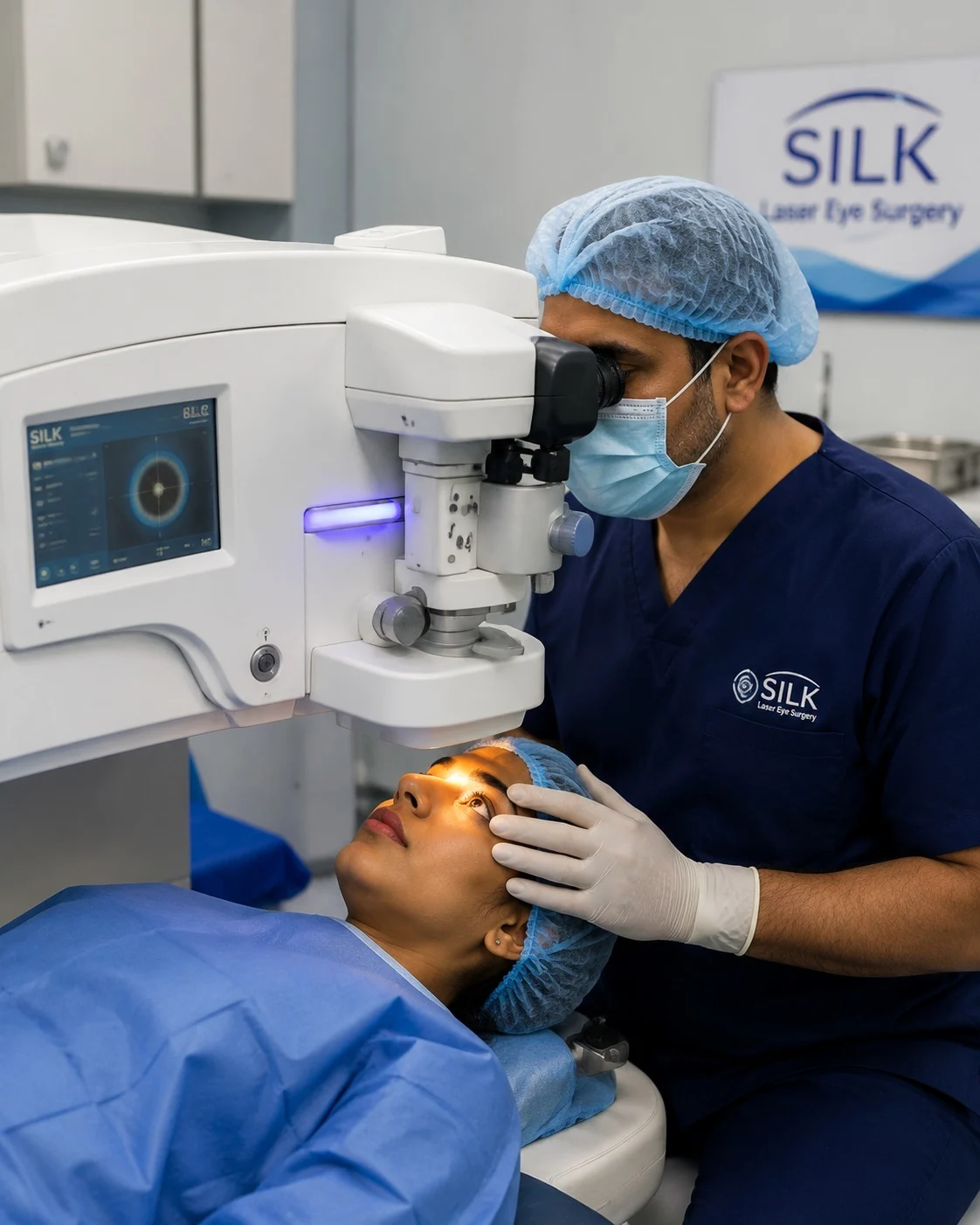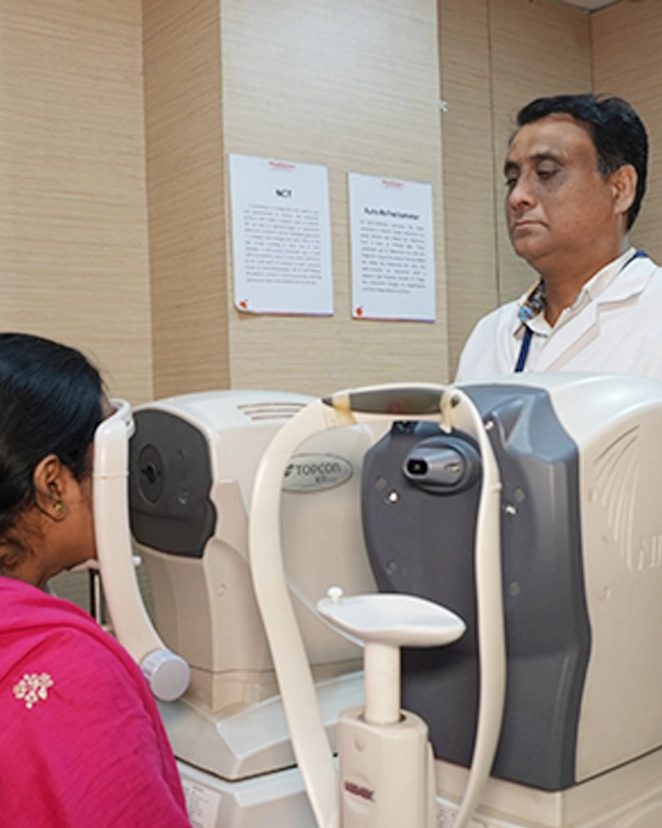
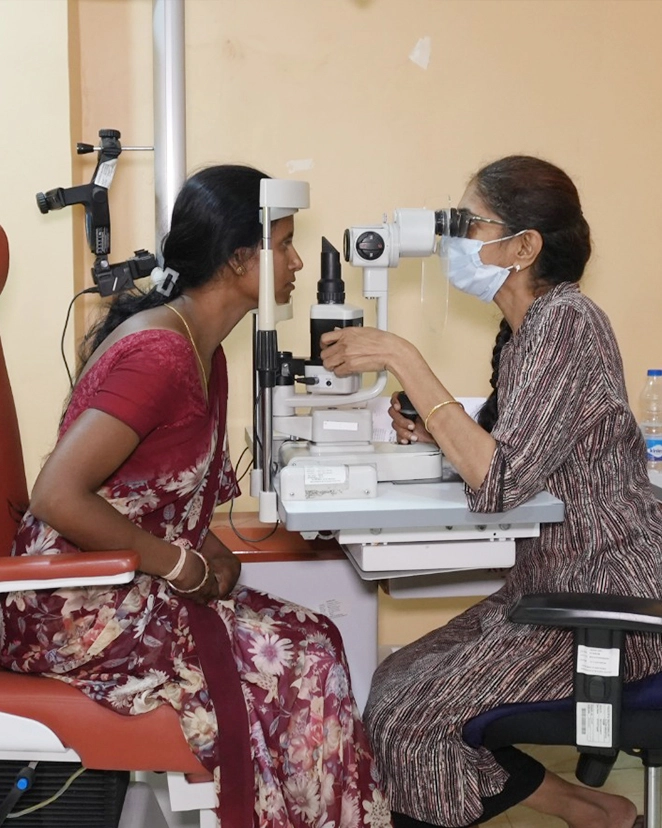
Two patients came to our KPHB centre in the same week, both minus 3.5 in each eye, both in their late twenties, both wanting to be rid of glasses. One had LASIK and was back at work in two days. The other was advised against laser surgery entirely and left with a referral for a specialist contact lens fitting. Same number on the prescription, completely different answer. The prescription, it turns out, is one of the least individual things about an eye.
The spectacle number describes the error, not the eye
Your power tells us how far your focus falls from the retina. It says nothing about the structure that has to be reshaped to fix it. A cornea is a curved layer of collagen roughly half a millimetre thick, and its thickness, its curvature, the regularity of its front and back surfaces and the health of the tear film sitting on it vary enormously from person to person.
The second patient above had a topography map showing a subtle asymmetry in the lower cornea — a pattern suggesting early keratoconus, in which the cornea progressively thins and bulges. Nothing about her vision or her prescription hinted at it. Laser correction removes tissue, and removing tissue from a cornea that is already weakening accelerates the process. There was no version of the surgery that was safe for her, at any price, on any platform.
That is the sharpest example, but the same logic runs through every decision we make in a refractive plan.
What the workup measures, and why each one changes something
- Corneal thickness, at multiple points. Sets the ceiling on how much correction can safely be done and often decides between LASIK, PRK and a flapless technique.
- Topography and tomography, front and back surfaces. The single most important safety scan. An irregular pattern rules out laser correction, sometimes permanently.
- Pupil size in dim light. Large pupils are more prone to night glare and haloes, which changes the treatment zone we plan and how we counsel you about night driving.
- Tear film quality. Marginal dryness before surgery reliably becomes worse dryness after, particularly with a flap. It is treated first, then reassessed.
- Prescription stability over time. We want a year or two of steady numbers. A drifting prescription means the laser corrects where your eye is today while your eye keeps moving.
- A dilated retina examination. Short-sighted eyes are longer eyes, and longer eyes have thinner peripheral retinas. Weak spots there are silent and are best treated before, not after.
- Your age and reading habits. Past the early forties, full distance correction brings reading glasses forward. That has to be planned for, not discovered.
The examination takes two to three hours because of this list, not because of queues. Come with someone who can drive you home; the dilating drops leave your near vision blurred for several hours.
Where the personalisation actually happens
Three decisions, in order.
Which procedure. A thin cornea points to surface treatment or a flapless technique. Significant dryness points away from a flap. A job in the police, the armed forces or contact sport argues against a flap for life, not just for recovery. Long-sightedness points to LASIK or PRK, because flapless lenticule procedures currently treat short-sightedness only. High powers beyond the safe corneal budget point to an implantable lens rather than laser at all.
Which treatment profile. A standard treatment corrects your prescription. A topography-guided or wavefront-optimised treatment corrects your prescription plus the individual irregularities in your own cornea. For an average cornea the difference is small. For a large pupil, a mildly irregular surface, or someone who already complains of starbursts at night, it is worth having.
What we aim for. This is the part most patients do not realise is a choice. Full distance correction in both eyes is the usual target. But for someone in their mid-forties who reads all day, leaving the non-dominant eye very slightly short-sighted keeps reading comfortable at the cost of a little crispness at distance. It suits some people and irritates others, so it is trialled with contact lenses first rather than decided in theatre.
What personalised does not mean
It does not mean a premium tier you can purchase. Customised profiles cost more because the diagnostic and laser time is longer, but buying the most expensive option available is not the same as buying the right one. If your cornea is normal in thickness and shape, your pupils are average and your tear film is healthy, a standard bladeless LASIK will give you an excellent result and the extra spend buys you very little you will ever notice. We say that regularly and we mean it.
It also does not mean everyone gets an operation. Somewhere around one patient in five who comes for a refractive assessment turns out to be unsuitable, most often because of corneal shape or thickness, sometimes because their prescription is still moving, sometimes because their dry eye needs months of treatment first. A centre that finds every patient suitable is not personalising anything.
If you are considering it
Bring your old prescriptions if you have them, particularly any from three or four years ago — they are the cleanest evidence of whether your power has settled. Stop soft contact lenses for at least a week before the scans, and rigid lenses for longer, because lenses temporarily reshape the cornea and will distort the very measurement the decision rests on. Ask to see your topography map and have it explained.
Our KPHB centre runs full refractive assessments and offers both LASIK and SILK, with evening slots until 8:30pm for people who cannot take a working day off. You can read more about the procedures on the refractive surgery page, or book an assessment and see what your own scans say.